



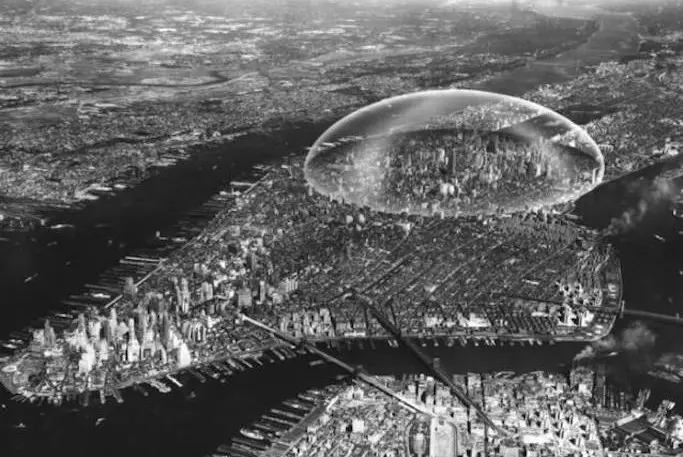
Image via Buckminster Fuller Estate
The novels of John Brunner have become a niche taste, even within his genre of science fiction. A more sociologically minded version of Philip K. Dick at his best, he could write with what now looks like a simultaneous prescience about the civilization to come and an apocalyptically anxious concern with the issues of his day. His undisputed masterpiece Stand on Zanzibar came out in 1968, the same year as the late Paul R. Ehrlich’s The Population Bomb. Both books deal with the dire consequences of what, at the time, looked like the runaway multiplication of humanity, though elements of the dystopian sci-fi writer’s vision now look rather more credible than the predictions of the Stanford biologist — apart from the giant geodesic dome covering Manhattan, anyway.
In a sense, Brunner was actually behind the times, since Buckminster Fuller himself had suggested doming Manhattan nearly a decade earlier. In their ambitious proposal for a “two-mile-wide Dome Over Manhattan” from the turn of the nineteen-sixties, Fuller and longtime collaborator Shoji Sadao “imagined a massive architectural surface that would regulate the city’s ecosystems,” write Next City’s Janette Kim and Erik Carver. “They delivered this design along with a series of surprising calculations: the Dome would reduce heat loss by scaling the city to one eighty-fifth of its surface area; the elimination of snowplowing alone would pay for heat; buildings inside the Dome could be built lighter and cheaper without need for weatherproofing; and interior air could be heated by remote plants.”
Fuller and Sadao did bring some numbers to back up their claims, but even more importantly, they made assurances that the dome’s glass would be one-way, a defense against prying non-Manhattanite eyes, and would keep residents’ cars and lawns in prime condition. However outlandishly forward-thinking Fuller could be, he never forgot that he needed to appeal to the worries and aspirations of mid-century America. As a personality, he also fit in well with the era’s enthusiasm for sweeping infrastructural fixes. “It was a time when people really believed in the power of technology,” says Never Built New York co-author Sam Lubell. “We’re building spaceships that go to the moon. Why can’t we build a dome over Manhattan to get rid of all this pollution, get rid of all the problems of weather?”
Still, as eccentric as he was, Fuller wasn’t delusional. “It’d be very worthwhile to have cities under geodesic domes, but New York City, if you think about all the different owners of different lands, the controversy about ‘this is my air rights, I don’t want a thing over my thing here,’ I just don’t think it’s going to happen,” he admitted. But “it can happen where you start out in places where energy is a really fantastic problem.” At the time, the ever-increasing demand for resources of all kinds by a rapidly growing population appeared to be not just a but the fantastic problem. Today, once-unforeseeable developments like rising energy efficiency and an apparently inexorable decline in global birthrates have directed our nervous gazes elsewhere. Yet dated visions of technological utopia and dystopia still strike us as oddly familiar — and indeed, as strangely similar to one another.
Related content:
The Life & Times of Buckminster Fuller’s Geodesic Dome: A Documentary
A Brief Introduction to Buckminster Fuller and His Techno-Optimistic Ideas
The Eden Project Built a Rainforest Ecosystem Inside Buckminster Fuller-Inspired Geodesic Domes
Better Living Through Buckminster Fuller’s Utopian Designs: Revisit the Dymaxion Car, House, and Map
When Frank Lloyd Wright Designed a Plan to Turn Ellis Island Into a Futuristic Jules Verne-Esque City (1959)
Based in Seoul, Colin Marshall writes and broadcasts on cities, language, and culture. He’s the author of the newsletter Books on Cities as well as the books 한국 요약 금지 (No Summarizing Korea) and Korean Newtro. Follow him on the social network formerly known as Twitter at @colinmarshall.