



Attorneys faced off in court again over the redevelopment of Pepper Square Friday morning, with a neighborhood association seeking a temporary restraining order barring the city from taking any further action to advance the project.
The plaintiff in the case, SAVE Pepper Square Neighborhood Association, argued that rezoning of the site to mixed-use is a case of illicit “spot zoning,” which is when a small tract of land is arbitrarily rezoned to a use that is inconsistent with the surrounding area and the jurisdiction’s overall zoning plan, often at the expense of the local community.
As previously reported by CandysDirt.com, the neighborhood group’s lawsuit claims the rezoning decision by Dallas City Council runs afoul of the city’s comprehensive land use plan, ForwardDallas 2.0, which advises “larger complexes, often with fewer stories” for more suburban parts of the city. Pepper Square is located in Far North Dallas, and the current plans for the project call for apartment towers as high as 11 stories.
Representing the neighborhood group, Austin Smith of the law firm Steckler Wayne & Love claimed the plaintiff would suffer irreparable harm in the form of property value decreases and increased emergency response times if the developer — Henry S Miller Companies — is allowed to move forward on their plans to introduce more than 800 multifamily housing units to the neighborhood.
“If we allow this development, we’re going to completely oversaturate the area with rental units,” Smith said, arguing Pepper Square would be better suited for community retail.
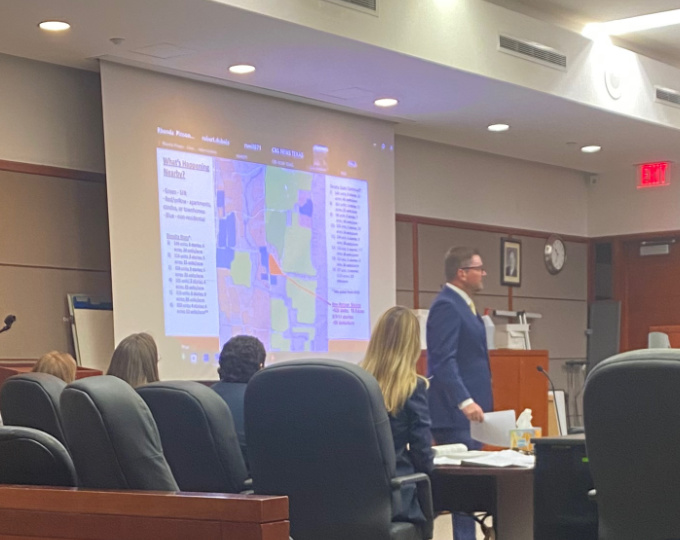
Attorneys for the defense included Lindsey Marsh Brown of the law firm Jackson Walker and representatives from the Dallas City Attorney’s Office.

Brown challenged the neighborhood association’s standing in the case, claiming no one affiliated with the group owned property within the notice area (200 feet) of the project. The plaintiff’s attorneys, however, referred to an affidavit filed just before Wednesday morning’s hearing identifying one such impacted property owner.
“This is essentially a last-ditch effort for the plaintiff to overturn a well-sought, authorized decision made almost a month ago … by elected city officials after a robust and vigorous process by which the zoning ordinance was approved,” Brown said.
She argued her client would suffer irreparable harm from a temporary restraining order, claiming every week of delay would cost the developer as much as $290,000.
Dallas County Judge Martin Hoffman said he was sympathetic to the neighborhood group but noted that he had “very limited discretion” in the matter.
“This is a political decision that’s being made,” Hoffman said. “If the neighborhoods don’t like this type of development, elect a new city council person. It shouldn’t be the role of the judiciary to make this type of decision.”
Council Member Jaynie Schultz (District 11), who represents the district where Pepper Square is located and voted in support of rezoning, is not running for reelection. The controversy over the development has in part framed the race in the district, with most candidates lining up against the housing component of the development.
Judge Hoffman expressed his desire to see a case where a lower court overturned a jurisdiction’s decision on the basis of spot zoning that wasn’t subsequently overturned by an appeals court.
During the hearing, attorneys on both sides referenced case law related to spot zoning that could be at play. Hoffman directed them to submit briefs on those cases and ordered a follow-up hearing next week.
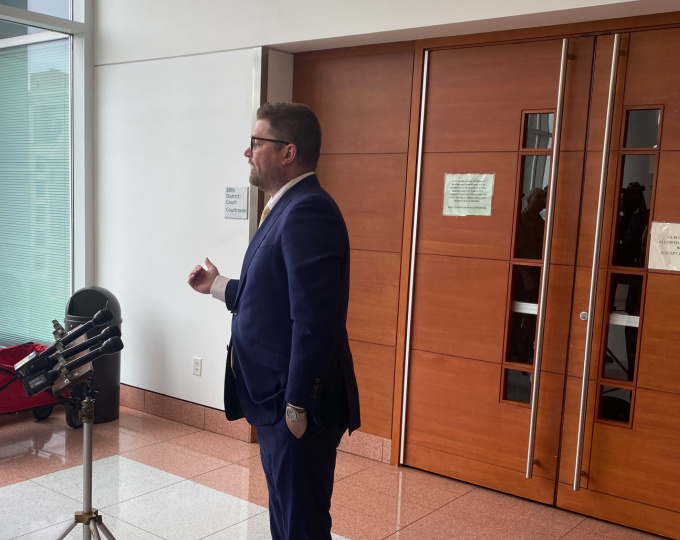
At a press conference held just outside the courtroom, Smith acknowledged his side faces some hurdles in proving spot zoning and that there’s little precedent on the question.
“We believe by not following ForwardDallas 2.0 — if they want to call it a guideline, it looks like more of a mandate to us — but I think that’s an arbitrary decision,” Smith said. “They just ignored it, and they want to push density into a neighborhood that doesn’t want this. Density is only going to go into the developer’s pockets.”