



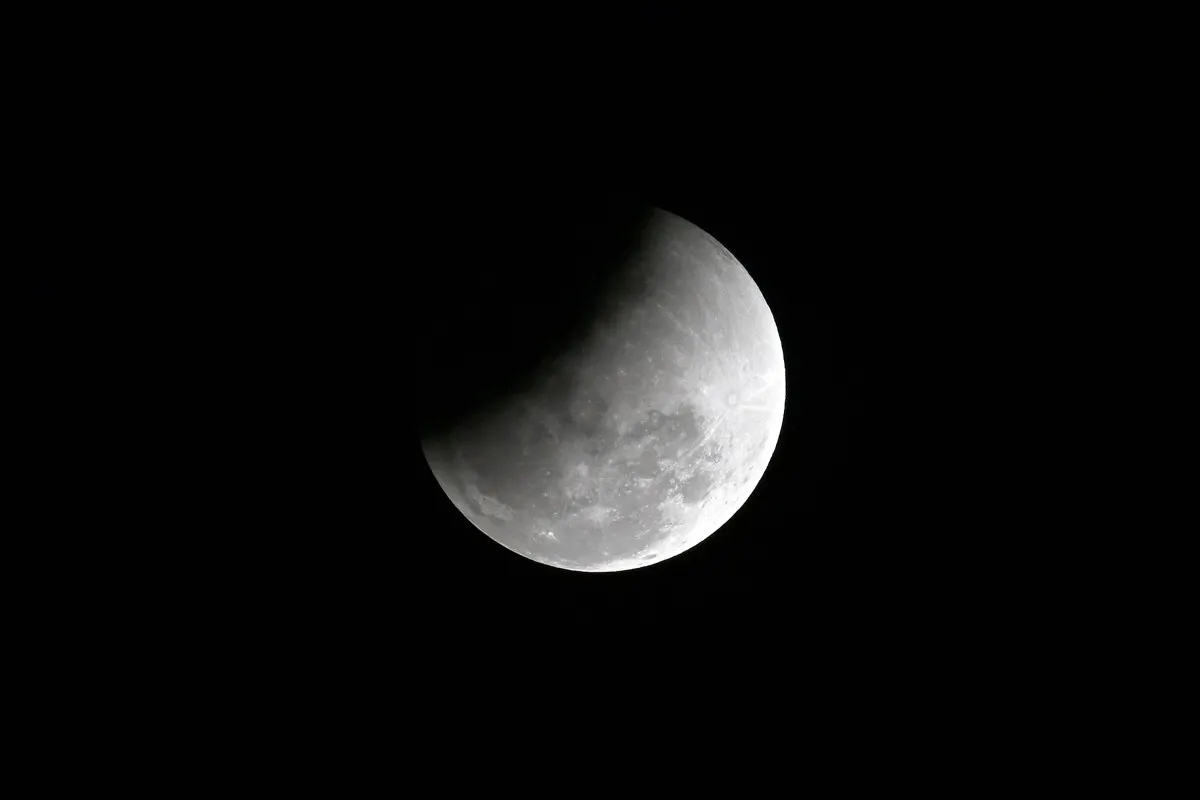
On Friday August 28th, another eclipse will take place in the skies above Spain. This time it will be a partial lunar eclipse.
After all the astronomical hype surrounding the solar eclipse a couple of weeks ago, along with the Perseid meteor shower, there’s a renewed interested in all things celestial.
The good news is you won’t have to wait long for the next event.
This Friday, August 28th 2026, Spain will experience a partial lunar eclipse in the hours just before dawn.
A partial lunar eclipse occurs when the Earth passes straight between the sun and the moon, casting its shadow on the moon.
Because this is a partial eclipse, only a fraction of the lunar surface will be covered in shadow, creating a classic dark crescent shape on the moon.
During a total lunar eclipse, a phenomenon called a blood moon occurs because the shadow gives the moon a reddish-orange tint or glow. During the partial one, however, the moon will remain the same colour, just darker because of the shadows.
The eclipse will take place in the early hours of Thursday, August 27th to Friday, August 28th. According to official data from the National Astronomical Observatory (OAN) and the National Geographic Institute (IGN), the moon will rise in Spain at 9:01 pm on the 27th and set at 7:47 am on the 28th. The partial phase of the eclipse will begin at 4:34 am and end at 7:52 am – one hour earlier in the Canary Islands.
The peak of the eclipse, which is when Earth’s shadow covers the largest percentage of the moon, will occur at approximately 6:12nam, just before sunrise. At that moment, Earth’s shadow will be projected onto 93 percent of the lunar disk.
Observing a lunar eclipse is completely safe with the naked eye and no glasses will be necessary, unlike the solar eclipse which occurred recently.
If you have them, however, binoculars or a telescope will improve viewing and make the shadow appear clear.
Viewing will be best in areas with very little light pollution, meaning it will better in the countryside, rather than in or near cities.
The lunar eclipse will be visible from anywhere in the Iberian Peninsula, the Balearic Islands, the Canary Islands, Ceuta, and Melilla, provided the skies remain clear and no cloud cover is present.
There will be a difference in viewing time, however. In central and eastern Spain, the Balearic Islands, as well as Melilla, the moon will set before the partial eclipse has finished, whereas in the rest of the country, including the Canaries and Ceuta, you will be able to see the whole process of the eclipse.
The next major celestial event will take place on August 2nd, 2027 when Spain will experience another total solar eclipse.
This time, the path of totality will be mostly seen from the southwest of the country.
It will also take place in the day time, unlike the previous one, which was near sunset and it will be able to be seen for much longer – up to four minutes in some places.
Finally, a third eclipse will take place in 2028.
READ ALSO: Q&A – What to know about the next two solar eclipses in Spain