



Activism
/
October 23, 2026
It’s been 10 years since he passed away.
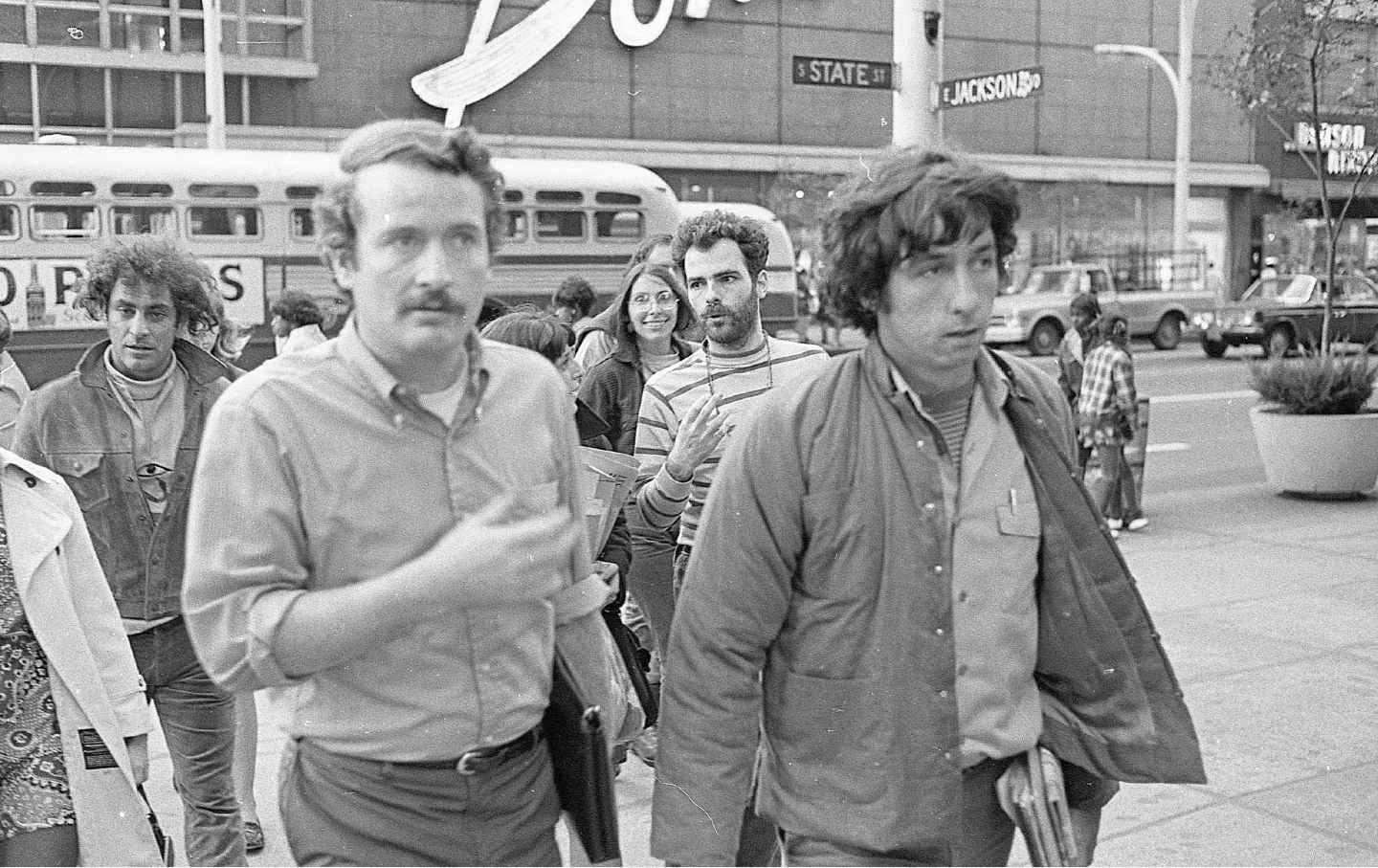
Standing in front of protesters on a misty day in Seattle, a 59-year-old Tom Hayden spoke into a bullhorn, declaring his hope. “I never thought the time would come that a new generation of activists would part the waters, the waters in which your idealism is supposed to be drowned.” The venerable activist, cofounder of Students for a Democratic Society (SDS), had spent almost two decades in the California State Legislature. But like other progressive legislators, he, too, was stymied by the conservative politics of the late 20th century. Earlier that day, tens of thousands of people—a historic coalition of union members, environmental activists, and anarchists—overwhelmed city officials and shut down the World Trade Organization (WTO) Ministerial Conference on November 30, 1999. It was the first major blow against the Clinton-era free-trade consensus.
The crowd repeated Hayden’s words through the “people’s mic” method and mirrored the then–state Senator’s visible giddiness toward the end of his remarks. “You have slowed the machinery of destruction down. But it can’t be about slowing the rate of destruction. It has to be about speeding the rate of creation of a new world, a better place.” Decades after he organized the landmark anti-war protests at the 1968 Democratic National Convention, Hayden was inspired by what he witnessed in Seattle. He could once again imagine a left that could win.
Tom Hayden passed away 10 years ago, on October 23, 2016, just weeks before Trump’s unexpected victory. As a result, his worst fears of an authoritarian right’s limiting the gains of the 1960s came true. Still, his life has become an even more relevant case study for those trying to figure out the most effective way to resist the current administration’s assault on democracy. As a lifelong insider-outsider, a Freedom Rider who later advised presidential candidates, Hayden was a passionate proponent of both radical direct action and electoral campaigns. Whether in the streets of American cities fighting back against ICE or in the offices of activist politicians like Representative Alexandria Ocasio-Cortez or Mayor Zohran Mamdani, today’s progressives are finding creative ways to build on the work of Hayden’s generation. As memory of the Vietnam War era fades, a reexamination of ecumenical organizers like him will strengthen our understanding of the links between the victories and defeats of the past and today’s attempts to build a better democracy.
Born in 1939, Thomas Emmet Hayden was a product of middle-class America. Coming of age as the American left was decimated during the Red Scare, he did not consider himself political until he learned about the sit-in movement in 1960. He was first arrested as a Freedom Rider in Albany, Georgia, on December 10, 1961, the moment he began work on the first draft of SDS’s manifesto, the Port Huron Statement. Completed by Hayden and other founders of the organization the following June, the document promoted participatory democracy, offered a powerful rebuke of the era’s Cold War consensus, and soon became required reading for organizers for decades to come. What began as a modest network of student leaders would grow dramatically following the expansion of the war in Vietnam, with approximately 100,000 members at its peak in the late 1960s.
Hayden became one of the leading figures of the New Left, a figure whom many reporters treated as an entry point to a new age of radicalism. Together with other SDS leaders, he helped establish community organizing projects in several cities, traveled to Vietnam, where he once facilitated the release of three American POWs, and was put on trial for conspiracy to riot as part of the Chicago Eight. Over time, the times increasingly radicalized Hayden, who vacillated between calling for “Two, Three, Many Columbias” and clinging to his battered but lingering hope for mainstream politicians like Robert F. Kennedy during his presidential campaign.
However, Hayden’s work stretched far beyond the 1960s. Like other New Left leaders, he is often tied to a narrative of decline about the New Left’s rise and fall, centered on the well-documented implosion of SDS in 1969. The truth is that Hayden’s life tells a far more complicated and representative story of the decade’s activism, its ongoing influence on today’s progressives, and the porous relationship between radicals and reformers in America.
Current Issue

Unlike some high-profile leaders of his era, Hayden remained dedicated to movement work. Instead of burning out, he gradually shifted toward more conventional tactics in the early 1970s. Together with his then-wife Jane Fonda, he led the Indochina Peace Campaign, which helped sustain the anti-war movement’s political power and cut off funding for the Vietnam War. Following an insurgent Senate campaign, he and Fonda established the Campaign for Economic Democracy in California in 1977. By the early 1980s, CED had become a statewide organization that helped pass rent control initiatives and elect dozens of local and statewide officials. Hayden won a State Assembly seat in Santa Monica in 1982, serving a decade as a state representative, then another eight years as a state senator. Despite Republican governors’ limiting him for most of his time in Sacramento, Hayden still championed environmental reforms, including the Safe Drinking Water and Toxic Enforcement Act of 1986, and pushed for peace among street gangs in Los Angeles.
After he was termed out of the State Legislature, Hayden taught classes on social movements, joined The Nation as an editorial board member, and once again became a fixture at anti-war rallies and other meetings in progressive spaces. During his brief stint as a fellow at Harvard’s Institute of Politics, he led a series of workshops, “Activism Now!: Students, Sweatshops and Globalization,” that culminated in a trip where four students were arrested while documenting planned protests against the Free Trade Area of the Americas. After Occupy Wall Street, Hayden was in regular contact with new movement figures such as Debt Collective cofounder Astra Taylor after the two appeared on a panel together in 2014. “Good luck to Strike Debt. As your generation’s prospects decline and a new Dark Age rises, I do think you have a window of glory ahead though,” he wrote to Taylor. It was one of many interactions where Hayden cheered on a new generation shaped by the WTO protests, the post-9/11 wars, and the 2008 financial collapse.
In his final years, Hayden tried to situate the Obama presidency within a longer history of protest that contributed to his 2008 victory. He encouraged progressives to celebrate the best elements of the 44th president’s foreign policy (Cuba, Iran) while remaining critical of the war in Afghanistan and the administration’s tepid domestic agenda. He drew links between the Black Lives Matter movement and his work in Newark and lauded the lobbying efforts of the Dreamers. In 2016, Hayden infuriated many progressives when he backed Hillary Clinton over Bernie Sanders just days before the New York primary. He saw it as a pragmatic choice, rooted in fears of a Trump administration and the future of the Supreme Court. Those fears were legitimate and have proven prescient, but his endorsement underestimated the Sanders campaign’s potential impact.
If he were alive, he would celebrate that 2016 was a real turning point for the American left, when countless young organizers began to seriously engage in electoral politics. While he never would have predicted that the Democratic Socialists of America would become the post-2016 left’s primary beneficiary (even though he spoke at their annual convention in 2013), he would praise its electoral work, especially in cities like New York City, Chicago, and Los Angeles.
Much as he felt witnessing the Battle of Seattle in 1999, Hayden would have been ecstatic to see how a broad cross section of ordinary people has stood up to masked ICE agents occupying American cities over the past two years. The Minneapolis protests and general strike were, in many ways, the model many others from the 1960s generation had dreamed of for decades. The former community organizer would have been moved by how Minnesotans courageously faced down the president and won.
It is, in fact, a new dark age, but it has also benefited from those who built on the work of figures like Tom Hayden. He recognized the long battle but was also often driven by his desire to take urgent action to confront injustice. His story reflects that of many from his era who spent decades searching for different channels for progressives to win political power. Hayden had a searching mind, open to experimentation and adapting to history. Throughout it all, he thought that radical grassroots movements could merge with conventional politics to create a new democracy.
More from The Nation
The calamitous history of America’s wars of choice.
James Carden
The Ohio GOP gubernatorial candidate has accused his Democratic opponent, Amy Acton, of lying about being raped when she was 12 years old.
Chris Lehmann

Trump turns to Russian oil to lower fuel prices in the United States ahead of the midterm elections, throwing Ukraine under the bus.
OppArt
/
Niels Bo Bojesen