



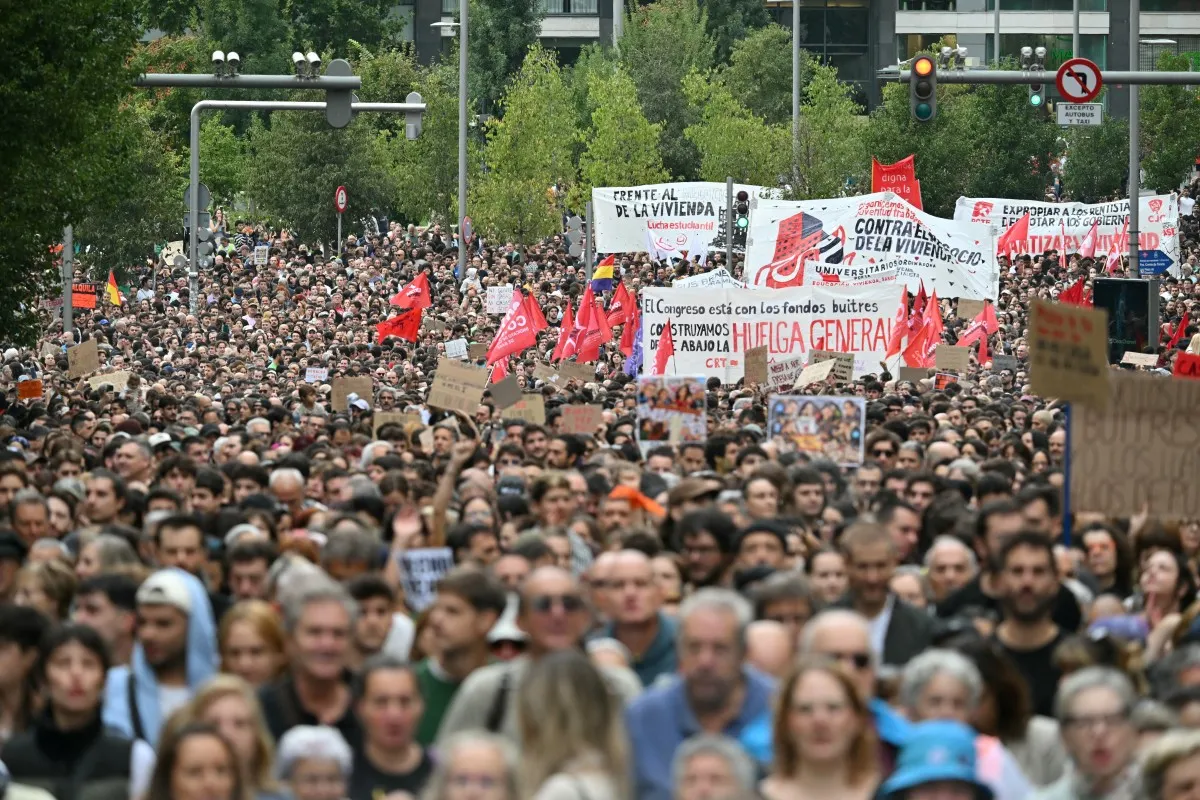
Police clashed with demonstrators in Valencia as thousands of protesters marched in cities around Spain on Saturday, a day after lawmakers rejected housing relief measures for tenants.
The demonstrations extended a crisis that has gone on for more than a week, triggered by the September 23rd forced expulsion of a pensioner from her Madrid flat.
Madrid council estimates say around 70,000 took to the streets in Madrid, while the organising Sindicato de Inquilinas put the figure at 500,000.
Demonstrations also took place in Barcelona and Las Palmas de Gran Canaria
In Valencia, where some 6000 reportedly marched, police clashed with protestors near the famous City of Arts and Sciences.
Nine officers were injured, according to police sources.
Spanish daily El País reports that “riot police have charged at demonstrators in Valencia who had made their way to the City of Arts and Sciences, where a property conference is being held. Some of them have managed to gain access to the building”.
The government introduced the measures after nationwide protests following the eviction, on a stretcher, of 87-year-old Maricarmen Abascal from a Madrid apartment she had occupied for around seven decades.
The defeat was another political setback for Socialist Prime Minister Pedro Sánchez and has renewed questions over whether his minority government can survive until the next scheduled general election in 2027.
READ ALSO: Spain’s PM mulls snap election in November if housing laws rejected
His government’s proposed measures, which included automatic renewal of tenancy contracts and restrictions on evicting vulnerable tenants, were shot down by opposition parties on Friday in Spain’s parliament.
The defeat infuriated those protesting the country’s increasingly expensive housing market.
Hundreds of protesters have been occupying a tent city set up a week ago in the heart of Madrid to press for reforms.
Marcos Sainz, a librarian of 26, used to rent a two-bedroom apartment with friends for a monthly rent of €900 ($1,000) but complains today a one-bedroom flat often costs €1,000 — or half the median monthly salary in Madrid.
He told AFP he will protest rental spikes “until someone dares to regulate it all as (otherwise) we’ll all have to leave Madrid and that would be a shame as I am from Madrid”.
Call for general strike
Javier, a solar panel installer of 31, explained that “we are demanding a fundamental right: decent housing, stability and conditions allowing us to construct a decent life project”.
He added that “I spend half of my salary on a tiny room”.
“What we are feeling in the streets is a new energy that we haven’t seen in a long time, and energy that is showing that eight days of people’s power can achieve more than eight years of progressive government,” Valeria Racu, one of the spokespeople of the Tenants’ Union organising the protest, said in a statement.
“Now begins real politics — politics which has always belonged to the people and which will return once and for all to the streets,” she said.
She repeated her union’s call for a general strike.
Housing has for years been a top concern for Spaniards as supply falls short of demand, with rents and house prices rising as elsewhere in the European Union.
Average rents in Spain have almost doubled over the past decade, while asking prices for homes have risen by about 90 percent, according to real estate website Idealista.
Abascal’s eviction catalysed long-running anger about runaway housing costs.
The pensioner was forced to leave the Madrid flat where she had lived for more than seven decades after it was acquired by an investment company that sought to increase her rent by 275 percent, according to housing campaigners.
The backlash led the property’s new owners to reach a deal allowing her to return to the flat at a low rent.
Early election call
The housing bills Sánchez’s leftist coalition had presented to parliament were rejected after the Catalan separatist party Junts — on whose support the government relies — voted against them, arguing they lacked rigour.
Junts joined the main opposition Popular Party (PP) and the far-right Vox party in shooting down the measures.
After the vote, PP leader Alberto Núñez Feijóo, urged Sánchez to “call elections as soon as possible”.
After eight years in power, Sánchez had the backing of “neither the streets nor parliament”, he added.
Recent opinion polls have generally placed the opposition Popular Party ahead of the Socialists.
READ ALSO: What are the main criticisms of Spain’s proposed housing law?
With additional reporting from Conor Faulkner.