



“Chișinău is a city of contrasts,” says Sasha, a young man in a baseball cap and beige jacket, with whom I chat over cigarettes and decaf coffee at the Casa Zemstvei community centre. His sentence sounds like a cliché, but as I stroll through the Moldovan capital of nearly three-quarters of a million people, I am reminded of it more than once.
Even in the city centre, low houses with wooden beams stand, often with handymen kneeling in front of them, hammer or paintbrush in hand. Wide avenues, where columns of cars and blue-and-white trolleybuses crawl, are lined with majestic Brutalist concrete structures and white limestone buildings adorned with Neoclassical reliefs. Yet, just a few blocks away, the grand Soviet-era boulevards are replaced by torn-up roads where, despite their dismal state, more cars are stubbornly parked.
“Does Chișinău feel like a European or a Soviet city to you? Last year, friends visited me here and said it felt European. It filled me with pride,” I heard in several variations during my stay.
Between war in Ukraine and European integration
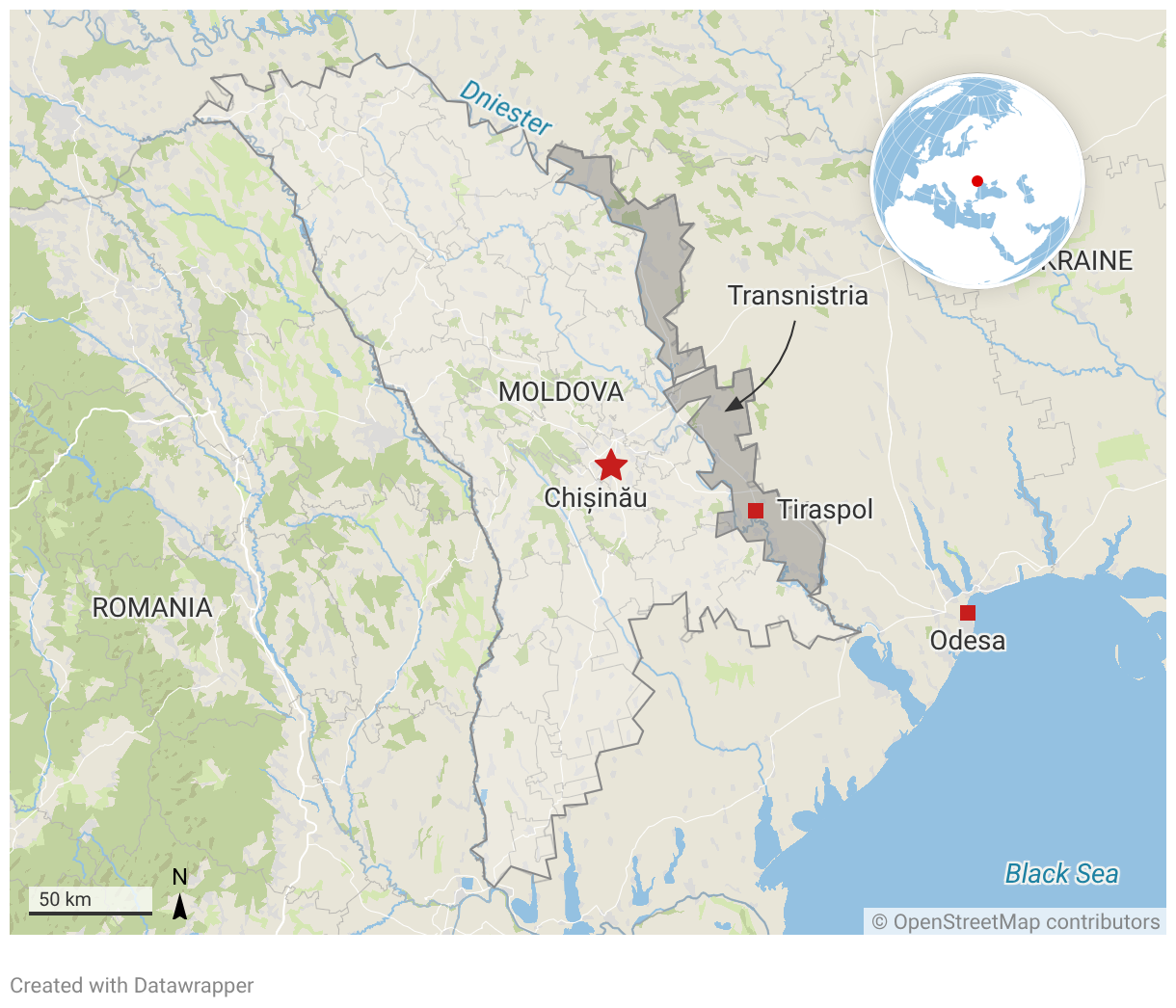
Since Russia’s full-scale invasion of Ukraine in 2022, geopolitics has dominated Moldovan public debate. Many feared that if Ukraine fell, Moldova – a country nearly twenty times smaller – would be next.
That did not happen, but the war next door affects Moldova directly. In mid-March, the government declared an emergency after fuel contaminated the Dniester River following a Russian attack on a Ukrainian hydroelectric plant. Moldova also suffers from power outages as a result of Russian strikes on Ukrainian electrical infrastructure.
The European Union opened accession negotiations with Moldova in December 2023. While countries such as North Macedonia or Serbia have remained in candidate status for over a decade and their near-term accession is unlikely, Chișinău is hastily adopting EU-required reforms, aiming to conclude an accession treaty by 2030.
The commitment was narrowly but ultimately confirmed in 2024 by two concurrent votes: a referendum on enshrining the promise of EU integration into the Moldovan constitution, and presidential elections in which Maia Sandu, of the ruling centre-right liberal Party of Action and Solidarity (PAS), won a second term. In 2025 when PAS won parliamentary elections.
However, those elections would have looked very different without the votes of the Moldovan diaspora – today approximately one million people.
Shortage of doctors and gravediggers
Moldova is among the fastest-depopulating nations on Earth. From nearly four and a half million in 1991, the population has fallen to fewer than three million people today. Every fifth child in the country grows up with only one parent – or none at all.
“When someone dies, local tradition calls for eight men to dig the grave. But in some villages, you can hardly find eight adult men,” says sociologist and journalist Vitalie Sprînceană.There country faces a shortage of gravediggers and of doctors; the population is ageing, and in the future there might not be enough taxpayers to sustain already meagre pensions and underfunded public services.

Moldova was long described as the poorest country in Europe, after severe economic crisis following independence from the Soviet Union,. It remains among the poorest – currently fare worse in terms of GDP per capita.
Mass emigration for work began in the 1990s. Initially it was primarily men, heading to Russia to work on construction sites, thanks to the visa-free policy and their mastering of Russian. After the Russian financial crisis in 1998, emigration shifter westwards, particularly to Romania and Italy, where Moldovan women filled the growing demand for caregiving.
At first, they had no choice but to cross borders illegally. That changed with Romania’s EU accession in 2007, which triggered another mass wave. Romania grants citizenship to anyone who held it before 1940 – when the Soviet Union annexed Bessarabia, the territory of modern-day Moldova, – including descendants up to the third generation. Today, roughly one-third of the Moldovan population holds dual citizenship.
“The best have left”
Another wave followed in 2014, driven byvisa-free travel to the EU and a widespread disillusionment after the “one billion” corruption scandal – a fraud in which one billion dollars was siphoned out of the Moldovan banking system. It implicated EU-sanctioned oligarchs Ilan Șor and Vladimir Plahotniuc, as well as former Prime Minister Vlad Filat, leader of the Liberal Democratic Party of Moldova, which took power in 2009 promising to deliver EU membership and prosperity.
This time it was the children of emigrants who had left at the turn-of-the-millennium who were emigrating in large numbers for the West. Unlike their parents, they weren’t leaving just because of the country’s miserable economic condition, but also because of thwarted political hopes and deteriorating public services.

“University education was a business at the time of my studies; diplomas were for sale. I had classmates who never showed up at school and yet achieved the best grades,” says Vlada Ciobanu, whom I met in the austere white office of the Center for Policies and Reforms, a civil society organisation focused on transparency and civic participation.
Ciobanu completed her bachelor’s degree in Moldova and went to the UK for her master’s. “The question wasn’t if I should do it, but when. If you finished a bachelor’s in Moldova, it was almost essential to do a master’s abroad,” she adds.
As sociologist and migration expert Alexandr Makuhin confirms, emigrating back then was simply “normal”: “If you wanted to build a specific career, succeed in science, or work for a multinational corporation, you had no choice.”
Sprînceană explains that just as social networks began playing a growing role, parties whose main programme was swift EU integration came to power. Consequently, the Moldovan public debate on emigration shifted fundamentally.
“One of the dominant narratives is the claim that ‘the best have left’. There is a grain of truth in that: since the 1990s, doctors, engineers, teachers, and scientists left to take jobs in the West far below their qualifications. Until 2010, however, the word ‘diaspora’ wasn’t used at all; people simply spoke of Moldovan Gastarbeiters,” Sprînceană outlines.
Between 2020 and 2025, Moldova lost more than 200,000 people
In the 2010s, thanks to the increased influence of new technologies, part of that diaspora began participating in domestic political affairs from abroad. “They started commenting on the domestic situation, expressing anger, sadness, and joy over what was happening here. And most importantly, they began participating in elections. The so-called pro-European forces realised that this was a huge electorate, very loyal to parts of their programme. And they began targeting the diaspora in their campaigns,” Sprînceană continues. Hence, the narrative that “the best have left” also expresses the dissatisfaction of part of the elite with those who stayed
In 2012, under the rhetorically pro-European government of Vlad Filat, the Diaspora Relations Bureau was created to strengthen ties between Moldovan emigrants and their homeland – and, crucially, to encourage them to return.
Gold rush
“Coming back to Moldova is like returning to the Wild West – like going to California during the Gold Rush. It is not easy at all. But now is the best time to come back. You have to work like a horse for a year or two, to prove yourself – and you’ll start making enough money for a life more comfortable than you would have in the United States or Europe,” says Vlad Vedrașco, 38,over breakfast in one the so-called “European restaurants” he favours.
The prices are indeed European: a large mineral water, a latte, an omelette, and roast beef bruschetta, comes to over €20 – in a country where the average salary is around €800 and only a third of workers earn above-average wages.
Vedrașco, the son of winemakers and an economics graduate, emigrated to the United States in 2013 in pursuit of the “American Dream”. He says he inherited the “entrepreneurial gene” from his parents and, within two years, had built a successful e-commerce business. “But spiritually I didn’t feel fulfilled; something inside me was empty. I think I was waiting for a reason to come back the whole time,” he says.
That reason came in 2018, when his parents were no longer able to manage the family winery. Today, he exports wine from his native village to the EU and shares his know-how with others in the industry. “I fulfilled my American dream in Moldova: I became a prosperous entrepreneur who positively affects others’ lives,” he says, and urges hesitant emigrants to return soon, because in fifteen years, he warns, it will be too late.
Building “European Moldova” despite labour shortage
The Moldovan government is actively trying to promote stories like Vedrașco’s to attract young professionals home. Most returnee programmes target small entrepreneurs, offering them tax breaks and grants. The government also appeals to the desire to meaningfully shape a country in transformation and build a “modern European Moldova”. European funds are flowing in the state needs people, and careers in public administration can advance quickly.
It is no different in the civil sector. “If you want to do something in your community or get involved in civil society, you see results relatively quickly – especially now, when the local and central governments are somewhat more open than before. You feel that you matter and that your voice has weight in a way it wouldn’t abroad,” Vlada Ciobanu says. She returned to the country in 2013, when the decline of democracy under Vlad Filat’s corruption was already visible.
‘University education was a business at the time of my studies; diplomas were for sale. I had classmates who never showed up at school and yet achieved the best grades’ – Vlada Ciobanu
“Everyone looked at me a bit weirdly. Returning from abroad was seen as a failure back then, as proof of a lack of courage. In the following three years, most of my friends left. Some claimed they would return when the country was in order, when there was more democracy. But who is going to make that happen?” she asks with a wide smile.
‘Better poor at home than rich abroad’
Salary conditions in the public and civil sectors remain poor compared to the private sector. The more so in the context of the war in Ukraine, which caused an energy crisis and high inflation that has pushed Moldova into IMF borrowing and the accompanying austerity.
On a morning sunny spring day, I travel to a secondary transport school in southern Chișinău with Stela Crudu and her brother, the writer Dumitru. Stela arrived from her village in the north for a parent-teacher meeting. She was originally supposed to arrive by bus, but the bus never came, so she arrived two hours late by taxi.

Stela went to Italy to work as a caregiver after falling behind on loan repayments. She spent two years paying off the debts and three years more saving money, before returning home. “Milletrecento, millequattrocento euro”she says carefully – in Italy, she earned about €1,300 or €1,400 a month.
Today, she works in a car factory in her village for “quattrocento, cinquecento euro,” – roughly €400 or €500. But she says she’d rather be ‘poor in my homeland than rich abroad. Besides,” she adds “in our village, I can live in my own house and have animals.” Stela lists the animals she has: cows, horses, and two hamsters, one of whom is aggressive. “Morde,” Stela explains – it bites – and snaps her teeth with a grin
While Stela is in her meeting, I speak with Alina, a French teacher who spent “five years, eight months, and two days in Rome with her husband”, as she recalls precisely. “It was an opportunity to learn so many things; it opened my horizons!”, says this elegant woman in a red blazer. “We integrated well… but in your native land, you breathe differently,” she adds.

She enthusiastically describes how the Moldovan education system is moving forward and how proud she is to contribute to it thanks to her experience abroad. When I ask about working conditions, she pauses.“I am an optimist; I don’t usually complain. But… It’s true that the economic situation in public education is somewhat unfortunate. In private education, salaries are dignified; and this is why the motivated and creative people work there.”
Alina believes that the state should actively support all returnees, not just entrepreneurs. “I know people who returned, stayed here for two or three years, and then left abroad again.” A moment later, sitting with Stela and her daughter on a café terrace in the park. I ask her daughter where she sees herself after school. With no hesitation, she says she will go abroad . She doesn’t know where or what for – she is fifteen, after all – but she wants to leave.
The vast majority will not return
As migration expert Makuhin confirms, no reversal of the emigration trend is underway. Between 2020 and 2025, Moldova lost more than 200,000 people. Those who do return do so primarily for personal reasons. Many of those who left are now more strongly attached to their adopted country – by work, house, family.
“Government programmes aimed at the diaspora often focus on culture, trying to play on nostalgic feelings: you are Moldovan, come back to your country, we will welcome you here! It may sound cynical, but the most effective way to get the diaspora to return is economic support,” Makuhin says.

Ciobanu goes further: the promise of a good job is not enough. “We need better public transport, a social system, affordable housing – which is not talked about. Dorin Recean [the former Prime Minister] just stated that it is better not to intervene in the housing market, which contradicts the experience of other countries.”
When I ask Sprînceană what the government should do to attract lost citizens back, he answers with a question: “Do we really need it? The vast majority of Moldovan emigrants will never come back. There is no point in spending public resources trying to convince the unconvincible. Yes, Moldova needs people. But in so many regions of the world, life is much more difficult than here. For many people in the world, Moldova represents an attractive destination.”
A perfect country to unlearn and to deconstruct
I spent Saturday evening in Chișinău at the closing party for the Casa Zemstvei community centre. It is the only place of its kind in the city. For fifteen years, it hosted a Queer Café, screened independent films, held lectures, or just provided a space for the shared joy of karaoke. Now the National Museum of Ethnography, which owns the building, declined to renew the lease, reportedly planning renovations.
During the affectionate closing speeches, a short-haired woman with emigration experience takes the microphone. “For me, after returning from Romania, Casa Zemstvei represented a place where I experienced so many magical things, where I reconnected with people, and where I fell in love,” she says.
Later, in the garden, I find myself next to a dark-haired woman telling how, during her studies in Italy, no one initially wanted to supervise her thesis on anarchist governance in practice. “Everyone kept saying it was a utopia; they lacked imagination. We still have so much to unlearn, so much to deconstruct!”
I ask her why she returned from Italy. “What is there to do in Italy?” she replies. I return the question: “What is there to do in Moldova?” She doesn’t hesitate: “It is a very small and dynamic country. We are constantly building, reconstructing, destroying, and searching for something new. Moldova is the perfect country to unlearn and to deconstruct. Much better than the West.”
👉 Original article on Deník Référendum
🤝 This article is s part of a cross-border European journalistic collaboration within the EU Neighbours East project.
o
Do you like our work?
Help multilingual European journalism to thrive, without ads or paywalls. Your one-off or regular support will keep our newsroom independent. Thank you!