



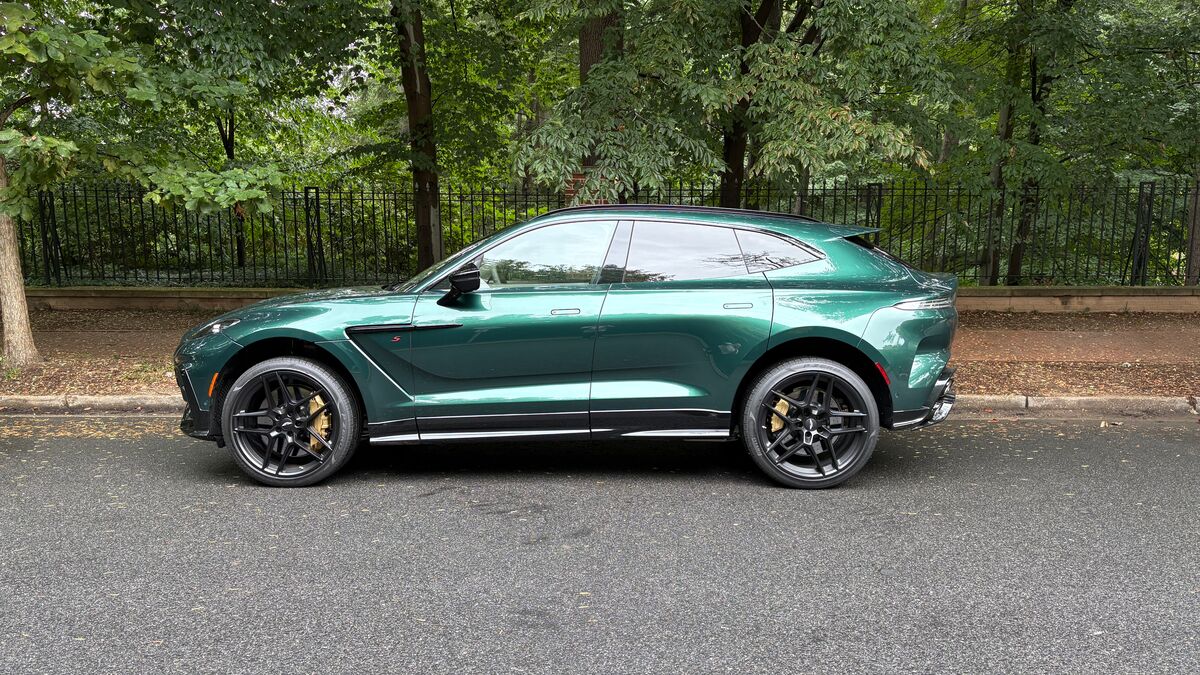
I’ve driven and reviewed hundreds of cars over a quarter of a century, and the 2026 Aston Martin DBX S is one of the vanishing few that has made me change my mind about something fundamental.
The meaning of luxury has evolved.
One of the automotive industry’s oldest trends is easy to understand: car features democratize over time. Automakers introduce a new feature on high-end, ultra-luxury cars. It’s rare, at first. But, as they build more of it, it gets cheaper to build. Through economies of scale, it makes its way down into upper trim levels of more affordable cars, and, eventually, even to economy cars.
This has reached extremes.
Not long ago, I sat in a 2026 Nissan Leaf — at the time the most affordable electric car in America — and marveled that it had convincing synthetic leather, an expanse of curved screen that mirrors your phone, an electrochromic roof, headrest speakers, and other features you’d have expected only in luxury cars not long ago.
By the old rules, this gorgeous Malachite Green DBX S, with its nearly $350,000 price tag, should have luxuries Nissan shoppers have never even imagined.
It doesn’t. No massaging seats. No self-driving tech. No whiz-bang technologies you have to research how to use.
Instead, the DBX S has a savagely powerful engine, steering, and suspension tuned with passion, and, if you want it, a baffle to make the exhaust louder. It’s not loaded with new technologies. It’s a brutally pure thing.
The 2026 Aston Martin DBX isn’t a multitool. It’s a knife.
It’s a finely made, art-quality Damascus steel knife, signed by the master smith who forged it, hand-sharpened for hours.
You can cut with a multitool, and you can cut with a museum-quality, one-of-a-kind chef’s knife. But you have to reach a certain level of resources in life for the fine knife to make sense as an investment when weighed against a multitool.
I spent a week driving the DBX S around Washington, D.C., and its suburbs, and it changed my understanding of luxury.
You don’t pay more for the DBX because it has more features. You pay Aston Martin to strip them away. In the 2026 of the fancy Nissan Leaf, luxury is the ability to buy an exceptional single-purpose tool.
Which Trim Level
Aston Martin builds just two versions of the DBX: the 697-horsepower 707 and the 717-hp DBX S. They loaned me the S. Its configuration added more than $60,000 worth of options, including a $21,600 set of magnesium wheels. Wheels are what automotive engineers call “unsprung weight” — they sit outside the suspension, so they pull against it in hard cornering. Lighter wheels can drastically improve track performance. Spending a Nissan Versa’s price on reducing unsprung weight makes sense for track cars, but sitting at the traffic lights of the nation’s capital, they felt like perhaps a bit underutilized for the price.
Favorite Feature
Purists deride the idea of an Aston Martin SUV because an SUV’s greater weight and higher center of gravity tend to make for slushier handling. But Aston Martin’s suspension engineers have worked incomprehensible magic to make the DBX handle like a lighter car. That comes in part thanks to weight savings. Tricks like a carbon-fiber roof and a honeycomb grille make the DBX almost 500 pounds lighter than a BMW M5 sedan. It also comes thanks to a triple-chamber air suspension, active anti-roll technology, and a steering system recently recalibrated with a shorter steering arm to tighten the feel. The result? I’ve driven sports coupes that felt looser than this 5-seater.
What It’s Like to Drive
A twin-turbo 4.0-liter V8 sourced from Mercedes’ famous AMG performance shop, full of rage, waits for you under the vented hood of the DBX S. In GT mode (the tame one), it’s surprisingly well-suited for a casual drive in traffic. In Sport, it wakes up, growls, and gets a little touchy. In Sport+, it’s loud and gets the car from zero to 60 mph in just 3.3 seconds, Aston Martin says.
It also sounds glorious. Aston Martin knows this and provides a button on the console to open an exhaust baffle to make the rumble louder.
Handling, as noted above, is exceptional for an SUV. I didn’t test Terrain mode, but no one should be fooled into treating the DBX S as a rock crawler. This suspension is extraordinarily good at making a family-hauling SUV handle like a 2-seater sports coupe. It likely can venture off the pavement, but not go where Range Rovers go.
Stopping power comes thanks to carbon ceramic brakes designed to manage heat well during repeated hard braking. Brakes like that are often grabby on the ride to the drug store, but these manage everyday tasks casually.
Interior Comfort and Technology
The cabin of the DBX S is by no means Spartan, but it doesn’t lean on heavy technology and screen surface the way some rivals at this price point do. It makes clear that this is a driving tool, if a sumptuous one.
That means a highly sculpted dashboard hosting two screens where you’d expect to find them, both reasonably sized. It also means rows and rows of buttons — no need to learn touchscreen menus here. Machined steel rollers for temperature and volume feel heavy to the touch — a sign of quality.
My tester was upholstered in a coffee-and-one-cream shade of semi-aniline leather that Aston calls Bison Brown. As befits a car in this price range, the soft stuff is everywhere — good luck finding a piece of plastic you can touch in this thing.
The showcase technology here is Apple CarPlay Ultra. Apple CarPlay mirrors your phone’s screen on a car’s central touchscreen, giving you access to apps you might use on the move through voice control and screen taps. CarPlay Ultra goes a step further, taking over the driver’s instrument screen as well.
It means you can control the car from your phone, even changing the temperature and drive modes. That has pretty limited utility — you don’t pick up the phone while driving.
But CarPlay Ultra also lets you choose from several display screen styles. Want a prominent tachometer? Maps in the driver’s screen rather than the central touchscreen? You can adjust the driver’s display with your phone. That has a bit more utility, but it’s still something many luxury cars allow you to do without Apple’s intervention.
I found no reason to dislike CarPlay Ultra, but no real advantage to it, either.
The Bowers & Wilkins 23-speaker, 1,600-watt audio system is truly exceptional, delivering crystal-clear sound across the entire sonic range. But, as a $12,300 option, it should be.
Rear seat accommodations are large enough even for tall adults, with an unusual 40.9 inches of legroom. Shoulder and hip room, however, might be a bit tight for three.
Limitations
The DBX offers just 23 cubic feet of storage behind the rear seats. You’ll find more in some subcompact SUVs. This is the Aston Martin with the most space. It’s still not the car you’d use with a dorm room’s worth of furnishings.
Key Considerations
This car has few competitors, and each has a distinct personality. In this price range, the Bentley Bentayga is more sumptuous and less athletic. The Lamborghini Urus might beat it around a track, but I’d like to watch the race. The Ferrari Purosangue is even more exclusive and pricey.
But you don’t comparison shop hand-made chef’s knives, do you? You commission the one you want from an artisan you respect, and treasure it when it comes.