



BELGRADE — Former Bosnian Serb Army commander Ratko Mladic, who was convicted by The Hague tribunal for war crimes in Bosnia-Herzegovina, will be buried with state honors in Belgrade on September 7.
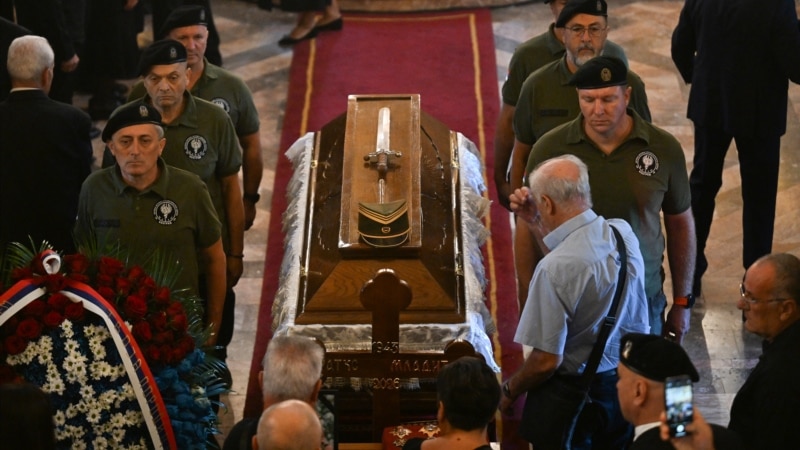
The coffin containing the body of Mladic, who died at the age of 84 on August 27 in The Hague while serving a life sentence for genocide and crimes against humanity, is lying in state at the Church of St. Luke in the Serbian capital.
Serbian Justice Minister Nenad Vujic previously said that Mladic would be buried with the highest state honors.
Several thousand people have gathered outside while a liturgy is held inside. Along with friends and family members attending the funeral, veterans of the former Bosnian Serb Army are taking turns to stand beside the coffin. Mladic will be buried at Topcider cemetery in Belgrade.
Srebrenica Massacre
Mladic took command of the Bosnian Serb army in 1992 and led a campaign that seized large parts of Bosnia. His forces laid siege to Sarajevo and carried out the 1995 Srebrenica massacre killing more than 8,000 Bosniak men and boys.
In 2017, the UN-backed International Criminal Tribunal for the former Yugoslavia convicted Mladic of genocide, crimes against humanity, and violations of the laws or customs of war.
Reporters from RFE/RL’s Balkan Service say numerous media crews are outside the church but have not been allowed to enter the cordoned-off area or the church.
Nearby streets have been closed to traffic, while police officers are stationed at intersections.
Early on September 7, four buses carrying demobilized members of the former Bosnian Serb Army left Banja Luka, the administrative center of Bosnia’s Serb-majority Republika Srpska, for Belgrade. The transportation was organized by the Republika Srpska Veterans’ Organization.
In the days since his death, tributes have been held across Serbia and Republika Srpska. A banner describing Mladic as a “hero” has been put up on a wall near the Church of St. Luke. A post on X shared by the Red Star Belgrade soccer team showed fans unfurling a tifo with a portrait of Mladic next to a banner with the words “Direction Potocari.”
Potocari, a village just outside Srebrenica, was the site of the Dutch UN base where thousands of civilians fled in July 1995 and where Bosnian Serb forces separated men and boys from women and children. It is now home to the Srebrenica genocide memorial.
Under Bosnia’s criminal code, public denial of genocide, crimes against humanity, and war crimes, as well as the glorification of convicted war criminals, are all punishable by law. Such offenses carry prison sentences of up to five years.
International Condemnation
On September 4, EU Enlargement Commissioner Marta Kos canceled a planned visit to Serbia after a government plane flew Mladic’s body to Belgrade, where soldiers carried his Serbian flag-draped coffin from the aircraft.
Politicians in the United States and Europe have condemned the public glorification of Mladic in Serbia.
Ahead of the funeral, US Senators Jeanne Shaheen, Chuck Grassley, and Keith Self released a joint statement, calling on the authorities in Republika Srpska and Serbia to distance themselves from Mladic’s funeral.
“It is deeply concerning that Serbia has announced Mladic will be buried with state and military honors. The coming days will be a test of whether Serbia and RS are ready to break with the past and move toward European Union membership and Euro-Atlantic integration,” the statement reads.