



Every day, the Ukraine Battlefield update newsletter offers a clear look at how the war is unfolding on the ground. Subscribe for free here to get the full text delivered to your inbox.
Large nuclear exercise, activity in Belarus and warnings from Ukrainian intelligence – Russia is not winning, but may again be preparing something in the north.
- The legendary Mala Tokmachka is worrying the Russians – they “captured” it, but it is controlled by Ukrainians, who are reportedly preparing an offensive in the south.
- The land route to Crimea is no longer safe for Russia.
- Maps of the day: northern Ukraine; Zaporizhzhia region.
- Videos of the day: this is what the work of Slovak F-16s will look like – Russian Su-35s making close passes at a British aircraft; strikes on the land corridor to Crimea; the Russian Molniya drone trying to set anti-drone nets on fire; a mid-20th-century Bofors gun shooting down Russian drones; what the Russian interceptor drone looks like and how it works.
Large nuclear exercise, activity in Belarus and warnings from Ukrainian intelligence – Russia is not winning, but may again be preparing something in the north. Desperate people do desperate things, and Russia is not far from desperation. That is why, in recent days, a great deal of attention has been paid to an unusually large exercise of Russian nuclear forces, as well as to reports of a new threat to northern regions of Ukraine – including from Belarusian territory.
The Russian nuclear exercise is the easier topic. Strategic nuclear forces also took part in it, such as a Borei-class submarine in the following video. Nevertheless, this part of the programme can be seen merely as traditional Russian sabre-rattling.
The same applied to the video from the Russian military television channel Zvezda, which showed ground-based launchers, with RS-24 intercontinental missiles.
The situation is less clear in five regions in northern Ukraine, where the Ukrainian security service is carrying out a series of measures it itself described as “unprecedented”.
This was a response to the conclusions of a meeting of Ukraine’s high command on 20 May, after which Ukrainian pesident Volodymyr Zelensky announced that the Russians were considering a new attack from Belarusian territory towards Chernihiv and Kyiv, as well as from Russia’s Bryansk region.
“It is a real possibility,” said the commander of the Ukrainian army, Oleksandr Syrskyi. According to him, the Russian General Staff was actively analysing and planning operations in the north.
Belarus itself joined the Russian nuclear exercise on 18 May. Just under a week earlier, Belarusian president Alelxandr Lukashenka had announced the mobilisation of some specialists.
In response to the claims by Ukrainian officials about a growing threat, Lukashenka on Thursday reacted rather dismissively: “As for his [Zelensky’s] statements that Belarus will get involved in the war, I have just said that this will happen under only one condition: in the event of aggression against our territory.” Lukashenka claimed that there was no political or military need on his side for anything of the kind.
But still, in the northerly regions of Rivne, Volyn, Zhytomyr, Kyiv and Chernihiv, Ukrainians were organising cooperation between the SBU secuirty service, the army, the police, the National Guard, and border guards, which was to be “aimed primarily at preventing infiltration into border areas, acts of sabotage and terrorism, subversive and reconnaissance activities, and other war crimes”.
“If we are now talking about Belarus and about what is happening there, it is not because [direct involvement in the war against Ukraine] is now more realistic, but because we see that Putin is putting pressure on Belarus as never before,” the influential soldier and politician Roman Kostenko commented on Syrskyi’s statements. He said that, according to intelligence, Lukashenka was trying to resist and avoid entering the war.
At the very beginning of the invasion, however, he had already made his territory available to the Russians. They attacked from there, for example through Chernobyl towards Kyiv. At present, the Russians are using Belarusian territory to guide their drones attacking Ukraine.
Roman Pohorelyi from DeepStateUA assumed that, if anything happened, it would be more likely sabotage and reconnaissance operations and an attempt to destabilise Ukraine. On the one hand, he reassured that intelligence information should be taken seriously, but on the other hand “there is no evidence of a significant build-up [of Russian troops in Belarus]”.
He was very sceptical about the possibility of a direct Belarusian attack. He did not consider the Belarusian army capable of doing anything of the sort – all the more so as prepared units, defence in depth and difficult natural conditions were waiting for it.
The legendary Mala Tokmachka is worrying the Russians – they “captured” it already last year, but it is controlled by Ukrainians, who are reportedly preparing an offensive in the south. “From the western part of the Zaporizhzhia axis there is again evidence of a deteriorating situation, this time from the area around Mala Tokmachka,” the Russian Telegram channel Rybar wrote on Thursday shortly before midnight.
This source has been warning Russians for weeks about the deterioration of their situation on this sector of the front.
His latest appeal also has a humorous dimension. Mala Tokmachka is precisely the village about which a now-legendary time-lapse video was made. Its content is a compilation of statements by one of the Russian “talking heads” on state television. This is Boris Rozhin, who, starting from 5 May 2025, repeatedly said that fighting was going on in Mala Tokmachka, that it would be captured or had already been captured – which was never true.
Back to Rybar. It claimed that most of Mala Tokmachka was under the direct control of the Ukrainian army. It even admitted that it had positions in the fields to the south of the local prison. This in itself was nothing new; more reliable sources had long considered this self-evident. The novelty was that the Russians were admitting it.
The location of the prison, as well as the Russian view of the positions of Ukrainian troops, can be found on Rybar’s map in the inset at the top right. In addition, it shows Ukrainian attacks from Prymorsk on the shore of the former Kakhovka reservoir to Shcherbaky. That, however, is nothing new; Rybar has been drawing his maps of this sector in this or a very similar way for some time.
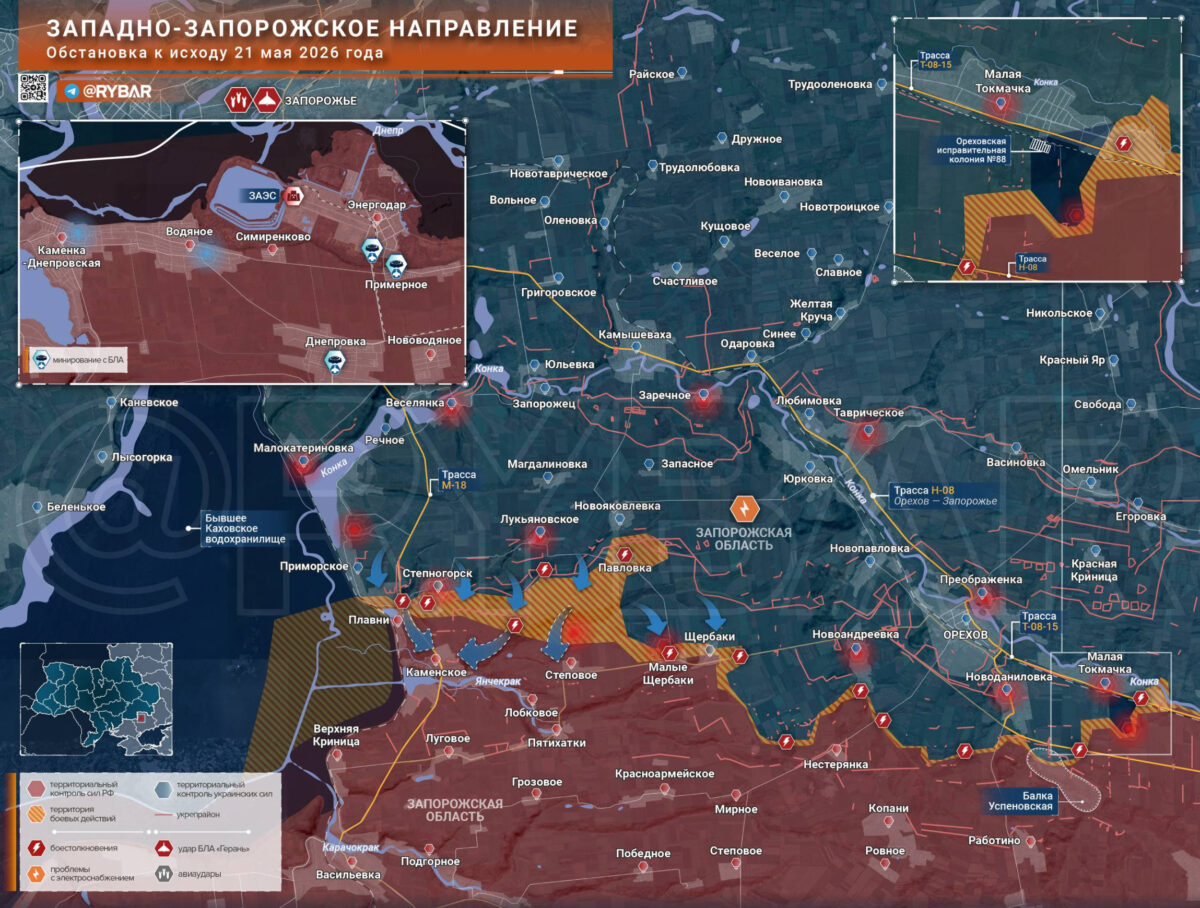
However, it linked the events here to the intensification of Russian drone attacks on the road from Mariupol to Melitopol and further to Crimea, which runs to the south of the area described.
“Given the marked increase in enemy unmanned aerial vehicle activity on the southern sections of the front in recent weeks, as well as systematic attacks on filling stations and on the logistics of the Russian army along the land route to Crimea, this is a sign that the Armed Forces of Ukraine have offensive plans,” Rybar concluded.
Russian Z-channels regularly report on such a threat, but nothing has ever come of it. Why do they do it ? From here, this is the shortest route to Crimea, and it was precisely in this area that the unsuccessful Ukrainian offensive took place in the summer of 2023. Its aim was exactly what Ukrainian drones are now trying to achieve – to cut Crimea off from the road from Mariupol and thus break the land corridor from Russia to the occupied peninsula.
It was from Mala Tokmachka (on the map above you can find it in the bottom right corner, south-east of Orikhiv) that Ukrainian mechanised columns set out in the first days of June 2023 for attacks that ended in heavy losses. The Ukrainian offensive then finally ground to a halt beyond the southern edge of the village of Robotyne, before the settlement of Novoprokopivka. You can find Robotyne directly below Orikhiv.
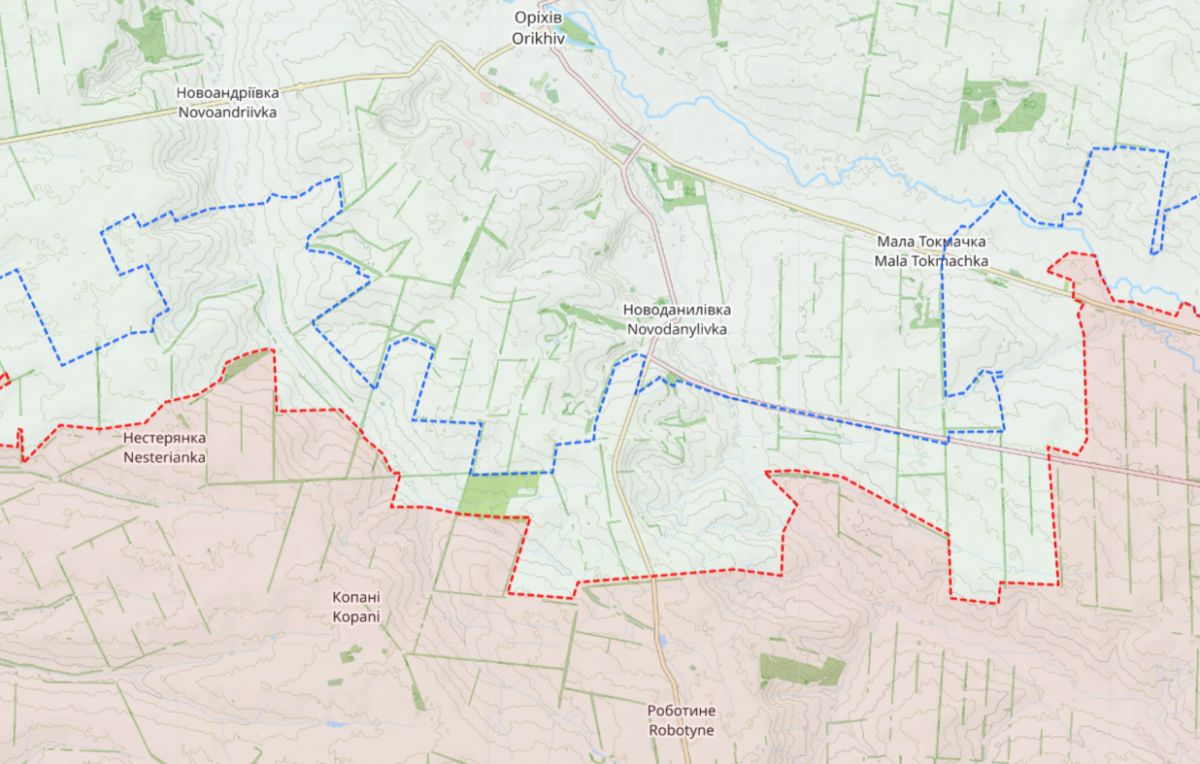
For comparison, here is the map by the Finnish OSINT group Black Bird Group. Orikhiv is in the centre at the top, Robotyne in the centre at the bottom, Mala Tokmachka on the right in the middle. If you ignore the difference in scale, this map and Rybar’s are very similar at this particular spot.
The land route to Crimea is no longer safe for Russia. When Rybar wrote about the alleged preparations for a Ukrainian offensive on the southern front and linked them to systematic attacks on filling stations in occupied territories and on Russian logistics, it had in mind the entire stretch of road from Donetsk to Mariupol and from there further to Berdiansk and Melitopol. From there, Crimea can be reached by two routes. The shorter runs via Chonhar, the longer via Armyansk further to the west.
On various sections of this route, attacks on trucks are increasing, as shown in the following compilation. Below it you will find a map with the locations of the strikes marked.
Videos of the day
Drones with thermite charges were briefly popular about two years ago. Apparently, they were not as effective as expected, because they quickly disappeared from the battlefield. But we may now be witnessing their return. According to the description, the Russian Molniya was trying to destroy anti-drone nets in Kostyantynivka using the same technique.
The first Bofors automatic cannons were introduced into service by the British army in the mid-1930s. The improved version you can see in the following video began to be mass-produced by the British in the late 1940s. Today, in the third decade of the 21st century, they are shooting down Soviet-designed drones attacking Ukraine.
Slovak defence minister Robert Kaliňák announced somewhat unexpectedly at the beginning of May that in 2028 Slovakia would send its new F-16s to the Baltic states to perform an air-defence mission. It was a surprise because the announcement came from an otherwise pro-Russian government. Even Kaliňák himself cast doubt on the idea that Slovak fighter jets would go there to face a real Russian threat, and obscured the true purpose of the exercise by claiming that the airspace of Nato members was also being violated by Ukrainian drones. There is, however, no doubt at all that the work of Slovak F-16s would look exactly like what the UK defence ministry showed on Thursday. The published video was shot from a British aircraft being approached dangerously closely by Russian Su-35s.
Much has been said about the medium-range Hornet drones, which are inflicting serious losses on Russian logistics in the rear. The Russians showed how they shoot them down using their Ёлка (Fir-tree) interceptor drones.
What are the losses
In May, some categories of equipment were removed from the list, which is why the overall figures fell significantly compared with previous weeks. No update since Monday (11 May).
By Monday (11 May), Russia had demonstrably lost 23,439 pieces of heavy equipment (on Tuesday (5 May) it was 23,650). Of these, 18,444 (18,618) pieces were destroyed by the Ukrainians, 971 (976) were damaged, 1,197 (1,206) were abandoned by their crews, and 2,827 (3,182) were captured by the Ukrainian army. This includes 4,390 (4,394) tanks, of which 3,293 (3,292) were destroyed in combat.
Ukraine lost 11,253 (11,219) pieces of equipment, of which 8,737 (8,708) were destroyed, 666 (661) damaged, 665 (666) abandoned and 1,185 (1,184) captured. This includes 1,422 (1,420) tanks, of which 1,087 (1,085) were destroyed in combat.
Note: Neither side regularly reports on its own dead or on destroyed equipment. Ukraine publishes daily figures for Russian casualties and destroyed equipment, which cannot be independently verified. In this overview we use data from the Oryx project, which since the start of the war has been compiling a list of equipment losses documented exclusively by photographic evidence.