


Shefaly Yogendra is one of the smartest people I know. I have said this to her before and I said it again on the day her book came out. She is whip-smart. She sees patterns before most people’s brains have even registered what is in front of them. I have watched Shefaly apply it across more industries and contexts than most people encounter in a lifetime.
Episode 171 of The Naina Experience was recorded on the morning of her book launch. Her book, Uncharted Spaces, was launching that evening at The Shard. It is her first book, and as she pointed out, the word “first” already carries an assumption that a second is coming.
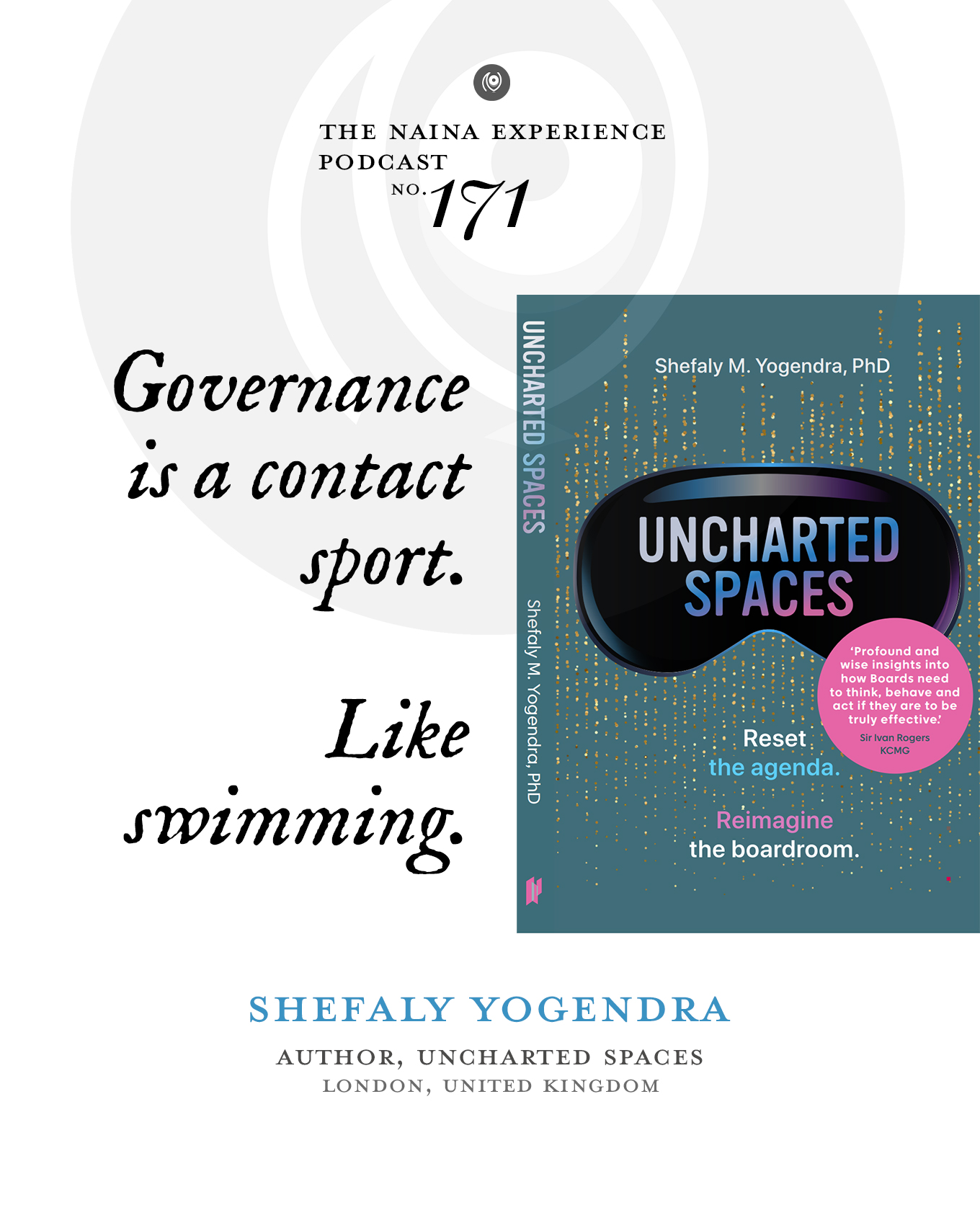
The cover of Uncharted Spaces has a pair of virtual reality glasses on it. When I asked why, she told me about a question a community of board directors had asked her the day before: how do you see the beginning of the beginning of something? Her answer is that you start to see when you engage with the world and observe without feeling the pressure to react. Most people listen to reply. Very few people listen to sit with something and make sense of it. The glasses are there to say one word. Look.
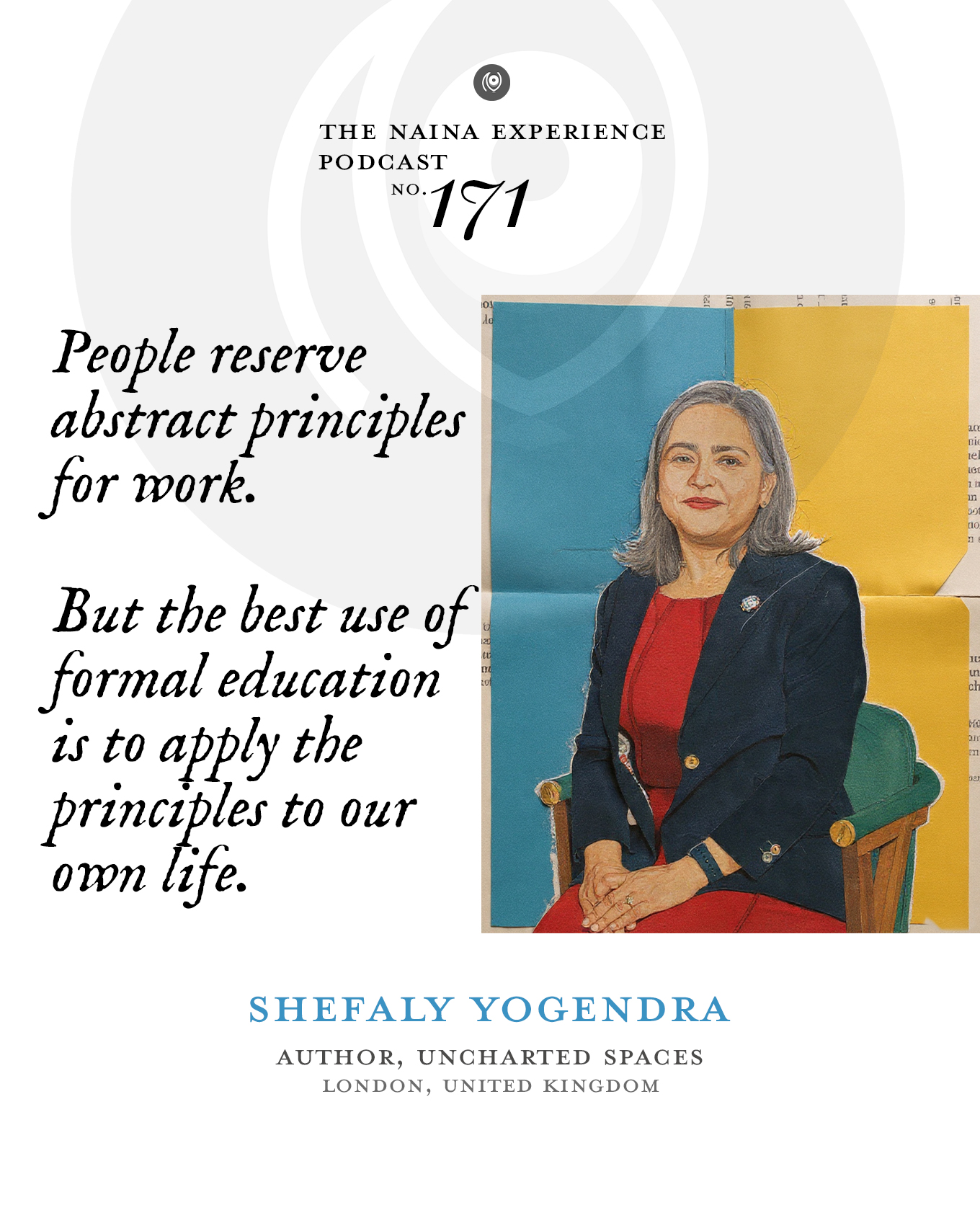
She introduced me to the word metacognition years ago, and I have associated it with her ever since. In the episode she explained it plainly. What we do is what we get engrossed in. The learning and the transferability come when we abstract one layer up. The skills you use to solve an engineering problem are the same skills you use everywhere else in life. The best use of formal education, she says, is to apply its principles to your own life. People tend to reserve abstract principles for work. They miss the point.
She brought this back to network industries. People think of the internet as a network, or mobile phone networks, or water. They do not think of roads as networks. But value is created every time something moves from one node to another, whether that something is a truck, an electron, water, or an idea. She and I were two nodes on a call between Australia and the UK, and the point of the conversation was to create something another person could use.
We talked about boards and what they actually do. The executive team runs the company day to day. The board helps shape and agree the strategy, makes sure the money and the people are there to execute it, and keeps an eye on whether the organisation is retaining its regulatory and social licenses to operate. Shefaly is clear that businesses operate because they have a social license, and when that license is violated, there are consequences. She gives the example of a large multinational beverage company accused of contaminating water in arid countries. In Australia, where water is precious, the example lands hard.
She also tackled boards across jurisdictions. The UK runs on a principle-based governance system. The US runs on a rule-based one. Principles allow judgment. Rules give you compliance or breach, nothing in between. A lot of Commonwealth countries run a version of the UK system. There is also an OHADA system that governs 17 Francophone countries in Africa, and Shefaly has quoted someone in the book who sits on boards under both OHADA and Anglo-Saxon systems. The mechanics of the meetings differ. She is careful to say that when you enter a new governance context, you spend your first 100 days listening. Two eyes, two ears, two hands, one nose. Observe, ask questions, then start to offer.
The phrase “trust in God, but lock your car” came up. I first heard it as a teenager and thought it was cool without knowing what to do with it. Shefaly’s reading is about verification. Start from trust. Then ask for evidence. When you are signing annual accounts or a compliance report, you do not begin by distrusting the process. You ask the process to show you it worked.
We spent a good chunk of the hour on why she wrote this book. A friend in a male-dominated industry called her in 2024 and asked, if you were starting out on boards today, how would you begin? Shefaly could not answer her. Her own start came through a Board Apprentice Program that has not scaled because host boards do not always show up for it. That question stayed with her. On top of that, she has had an unusually eventful ten years on boards. An IPO. An acquisition. A merger between two FTSE 250 companies that created a FTSE 100 company. A fund manager change conducted entirely on Zoom during the first COVID lockdown, when most people were still working out how to unmute themselves. A lot of people-related crises. A lot of hiring and intervention and conversations about leadership that she had done more of in ten years than in all the years before.
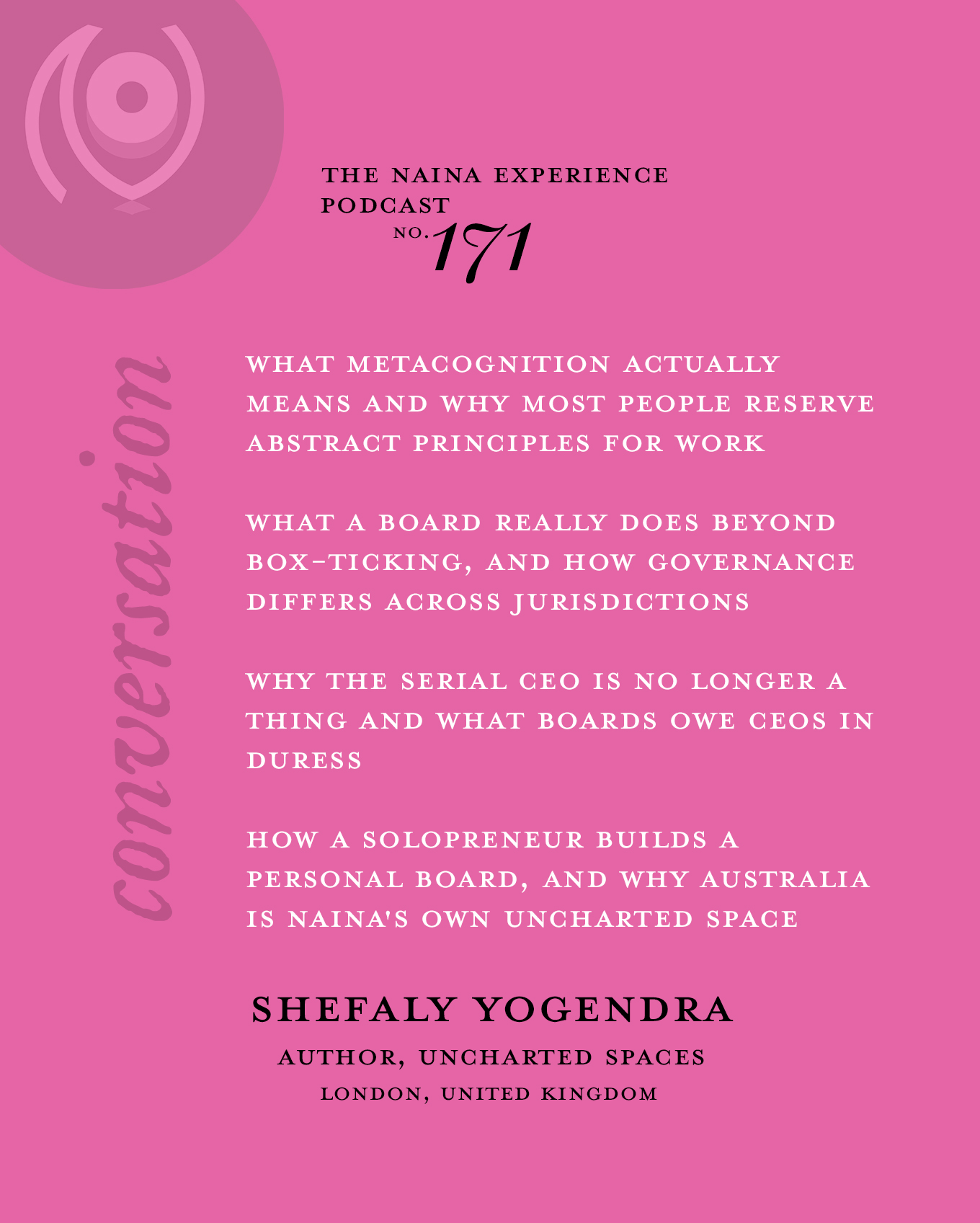
She also said something about CEOs that stayed with me. The stress on CEOs now is real and sustained. The serial CEO is no longer a thing. People do not want to do the job twice. If a CEO is having a breakdown, the board has both a human obligation and a legal one to stage an intervention, because a CEO can commit the company to decisions while their judgment is under duress. Very few people want to talk about this. Shefaly does.
The part of the conversation that mattered most to me personally was about building a board for yourself when you are a solopreneur. I do not have a board. It has been twenty-two years of working as an independent contractor and a freelancer. Shefaly’s advice is that a personal board is a real thing. A small group of people you trust, who understand you, who you go to not for daily contact but for sense-making, challenge, and support. Different people for different things. Some are good in peacetime, some in wartime. Do not send the peacetime ones to deal with a war. Know which is which.
She reframed Australia as my own uncharted space. I had not thought about it that way before. I had been framing it as survival mode. She called it a continent, a new culture, an opportunity, and pointed out that I was already seeding things with Adelaide Collective and the community I am building in person. The book, she said, is for me as much as it is for people who sit on boards.
We also talked about the epistemic crisis. The erosion of the fact base. People scrolling through so much information that nothing sticks, because there is nothing to stick it to. Conversations are harder because people are not bringing facts or stories, only opinions rooted in preference. Shefaly is blunt about this. It degrades public discourse. When public discourse degrades, democracies do too.
The book launched that evening at The Shard, in the offices of Amper, hosted by its CEO Sarah. Fiona, who wrote the foreword, was there. Shefaly’s first chairman from her board apprentice days was there. A community of women directors turned up. A photographer was taking pictures so I could see them from Adelaide.
Uncharted Spaces is available now. I will be highlighting my way through it.
Guest Links:
Book Instagram: https://www.instagram.com/unchartedspaces
Book Website: https://unchartedspaces.info/
Buy on Amazon:
Naina’s Links:
Book the podcast: https://www.naina.co/product/the-100-podcast/
Instagram: https://www.instagram.com/naina
Website: https://www.naina.co
Spotify: https://open.spotify.com/show/5HwVipVYnxARyEjp4onfvp
YouTube:
Watch the full episode on YouTube & Spotify