



David Souter (1939–2025) liked facts, and facts are anathema to movement conservatives.
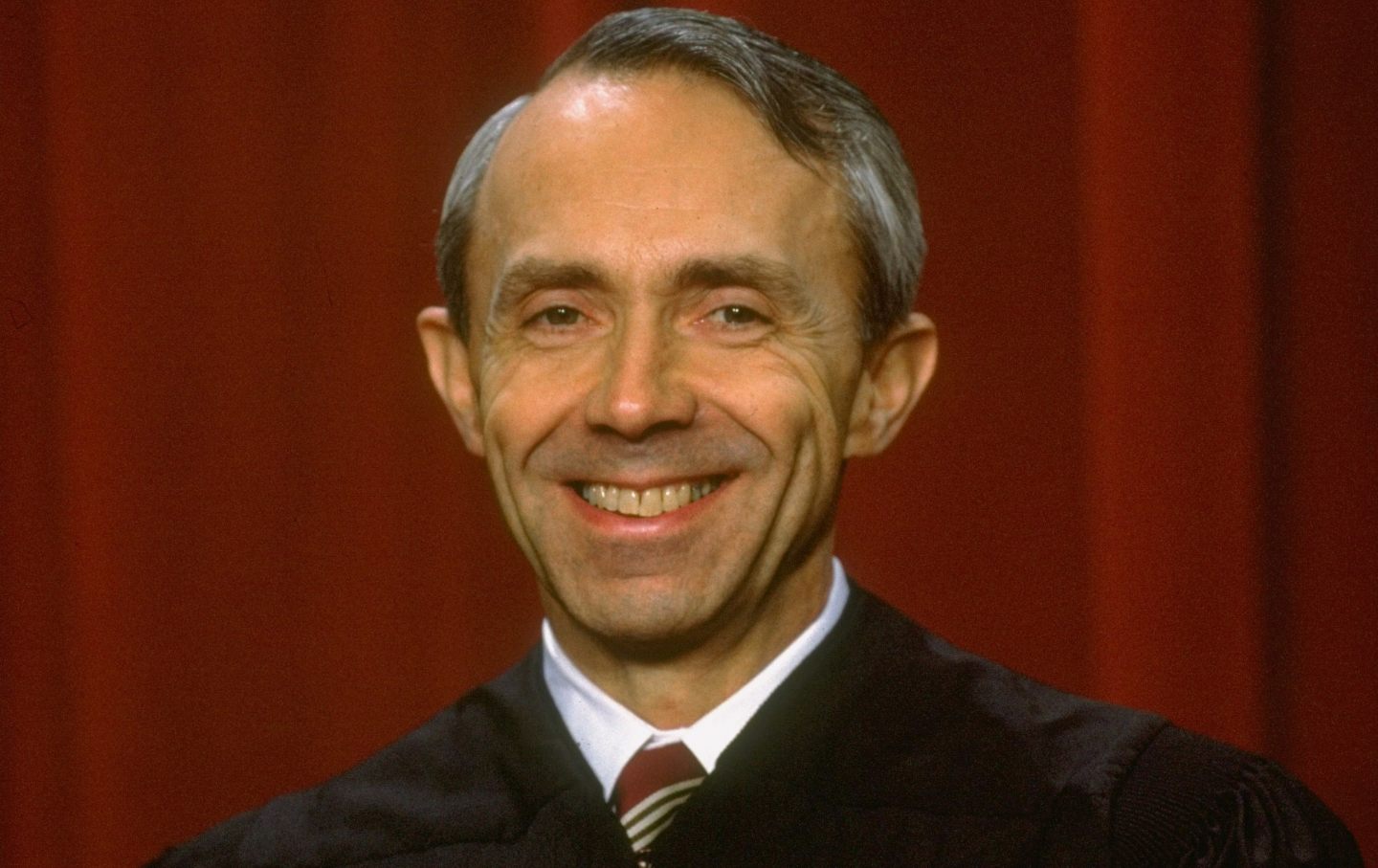
Supreme Court Justice David Souter.
(Diana Walker / Getty Images)
Former Supreme Court justice David Souter died on Friday morning at the age of 85. The Supreme Court did not issue a cause of death, reporting only that he died “peacefully” at his home in Concord, New Hampshire.
The one thing everybody knows about Souter is that he was a “Republican,” appointed by George H.W. Bush, who ended up voting with the “liberals.” That’s true, for what that’s worth, but the real story is deeper and more complicated than that.
Current Issue

To understand how Souter came to be viewed as a “traitor” to the white-wing conservative movement, you first have to understand something about the man he replaced, Justice William J. Brennan Jr. Brennan was the seventh-longest-serving Supreme Court justice in history, and a lion of the liberal wing of the court. He was the justice most people think Chief Justice Earl Warren was. He wrote over 1,200 opinions, and was one of the most influential justices to ever sit on the court.
Brennan had a stroke in 1990, and retired from the court shortly after, at 85 years old. The vacancy gave President George H.W. Bush the opportunity to make his first Supreme Court appointment.
Now, this is going to sound weird to people who are familiar with how Republicans treat the Supreme Court as a life-or-death struggle for white cultural patriarchy, but Republicans, much like today’s Democrats, once insisted on treating the Supreme Court as a nonpartisan branch of government. Upon nominating Souter, Bush said: “You might just think that the whole nomination had something to do with abortion… It’s something much broader than that. I have too much respect for the Supreme Court for that.” I know, I know, that quote sounds like it comes from the president of an entirely different country from the one we live in, and maybe it does.
The point is this: Bush the elder was never going to nominate a hard-right conservative to replace a liberal superstar like Brennan, and the Senate, controlled 55–45 by Democrats, would never have confirmed a hard-right choice.
Only a moderate, centrist, ruffle-no-feathers kind of Republican would get through the confirmation process, and Souter fit the bill. Souter had been a long-serving state Supreme Court judge in New Hampshire, who had been elevated by Bush just months prior to a seat of the First Circuit Court of Appeals. He had functionally no record that Democrats could attack him on: He had not been actively campaigning for a Supreme Court appointment and, so the story goes, had not even fully unpacked his office on the First Circuit.
He also had a powerful ally in his corner: former New Hampshire governor and Bush White House chief of staff John Sununu.
Souter sailed through the process, and was confirmed by the Senate 90-9. (Senator Pete Wilson of California did not vote, and Senators Ted Kennedy and John Kerry of Massachusetts voted against Souter—how do you like dem apples?)
Souter was never supposed to be a hard-right ideologue. That distinction would go to Bush’s next appointment, Clarence Thomas, who was considered for nomination after Brennan retired, but Bush wanted to “save” him for when Thurgood Marshall retired (because… they’re both Black, you see). Souter was always supposed to be a moderate conservative.
And he was. Souter did not become more liberal as he served on the Supreme Court—the Republicans on the Supreme Court became more extremist while he served, and Souter simply refused to descend into that kind of darkness.
Souter liked facts, and facts are anathema to movement conservatives. I think Oyez sums up his judicial philosophy quite nicely when they write: “Many of Souter’s opinions expressed a view that law should depend on underlying empirical facts and should change when those empirical realities shift.” Souter defended democracy, which meant that he defended the rights of the elected branches of the government (Congress and the president) to do pretty much whatever they wanted with minimal judicial intrusion. He was conservative, back when that meant something other than white-wing culture-war issues masquerading as law.
The difference between Souter’s practical conservatism and the right wing’s extremism came to a head in the 1992 case, Planned Parenthood v. Casey. That was the frontal challenge to Roe v. Wade that conservatives, with an 8–1 advantage on the Supreme Court, thought they could use to kill abortion rights. But they were mistaken. Souter and other Republican justices like Sandra Day O’Connor and Anthony Kennedy joined forces to write the majority opinion in that case that saved Roe. I’ve written about that case in detail and explained that it was the moment, the last moment, when practicality won out over ideology among some Republican justices.
Popular
“swipe left below to view more authors”Swipe →
Republicans never got over Souter or his vote in Planned Parenthood. By the time George W. Bush was appointed to the presidency by the Supreme Court (with the help of Souter, by the way, who joined the Republicans in Bush v. Gore, which ruled the Florida recount unconstitutional, while dissenting from the Republican majority’s opinion that no constitutional recount could be fashioned), there was an ongoing refrain within conservative circles: “No More Souters.”
I’d argue that Republicans reformed their entire judicial nominating process to avoid making another pick like Souter. Souter was the reason the Federalist Society got control of the Republican judge-making process. He would be the very last nonideological pick made by a Republican president. Don’t believe me? Here is the list of Supreme Court justices successfully appointed by Republicans after Souter: Clarence Thomas, John Roberts, Samuel Alito, Neil Gorsuch, Brett Kavanaugh, Amy Coney Barrett.
All six of those justices voted to overturn Roe v. Wade in Dobbs v. Jackson Women’s Health Organization.
While Souter made Republicans rethink how they went about nominations, he lulled the Democrats into a false sense of security and complacency about their own nomination process—and the fight for the courts. Souter (and O’Connor to a large extent) made Democrats think that Republican-appointed justices could be reasoned with and would rule on the side of law and practical realities instead of partisan politics. Democrats never really got the memo that Republicans had changed their entire strategy around the Supreme Court. The same Democratically controlled Senate that confirmed Souter also confirmed Clarence Thomas a year later. Somehow, Democrats couldn’t spot the difference.
Souter retired in 2009, at the age of 69. He was still a healthy man and could easily have served another decade. But he never took to Washington. He moved back to New Hampshire and went back to hearing cases on the First Circuit, the job he was never really allowed to have. His retirement gave Barack Obama his first Supreme Court vacancy, which he filled with Justice Sonia Sotomayor. Sotomayor presented as a moderate, centrist liberal—in the mold of Souter, actually. She’s probably slid to the left on the court far more than Souter ever did, but, ironically perhaps, she’s gotten there in the same way that Souter did: through being hyper-concerned about the underlying facts of the cases she hears.
A jurist like David Souter could never be appointed to the Supreme Court these days, by either party. The era when a president can pick a justice without knowing beforehand where they’ll fall on all of the most important issues and cases is over. Justices now need to prove they’ll align with the agenda of the president who appointed them, more or less. Each party has “litmus tests” and failure is not an option.
Most people will say that’s a bad thing, but I have no time for such wistful naïveté. The Supreme Court is the most powerful branch of government, the only one that can functionally veto the other two combined. As long as the court has the power to act like a partisan branch of government, it must be filled with partisans.
Souter is the appointment you make when you think the Supreme Court is above politics. But Souter lived long enough to see that the court simply doesn’t work that way anymore.
More from The Nation

A judge has halted the plan, but only a fool would believe the threat is now over.
Sasha Abramsky

Big-money donors are using the “abundance agenda” to create a permission structure for Democratic elites to dismiss the populist revival the party so desperately needs.
Aaron Regunberg
The Protect Our Workers Enforce Rights Act can serve as a model for cities all across the country.
Kendra Brooks

California officials shored up the state’s defenses to respond to Donald Trump’s lawless actions. But can their “Trump-proofing” strategy hold the line?
Sasha Abramsky

A Trump-appointed federal judge rejected a bizarre GOP attempt to disenfranchise voters after they cast their ballots.
John Nichols