



From 21 November, the EU will have to find new destinations for half of the plastic waste it currently exports outside the bloc. Under the EU’s new Waste Shipment Regulation, adopted in 2024, exports of plastic waste to non-OECD countries will be banned for at least two and a half years, with the aim of preventing environmental damage and ensuring waste is managed safely.
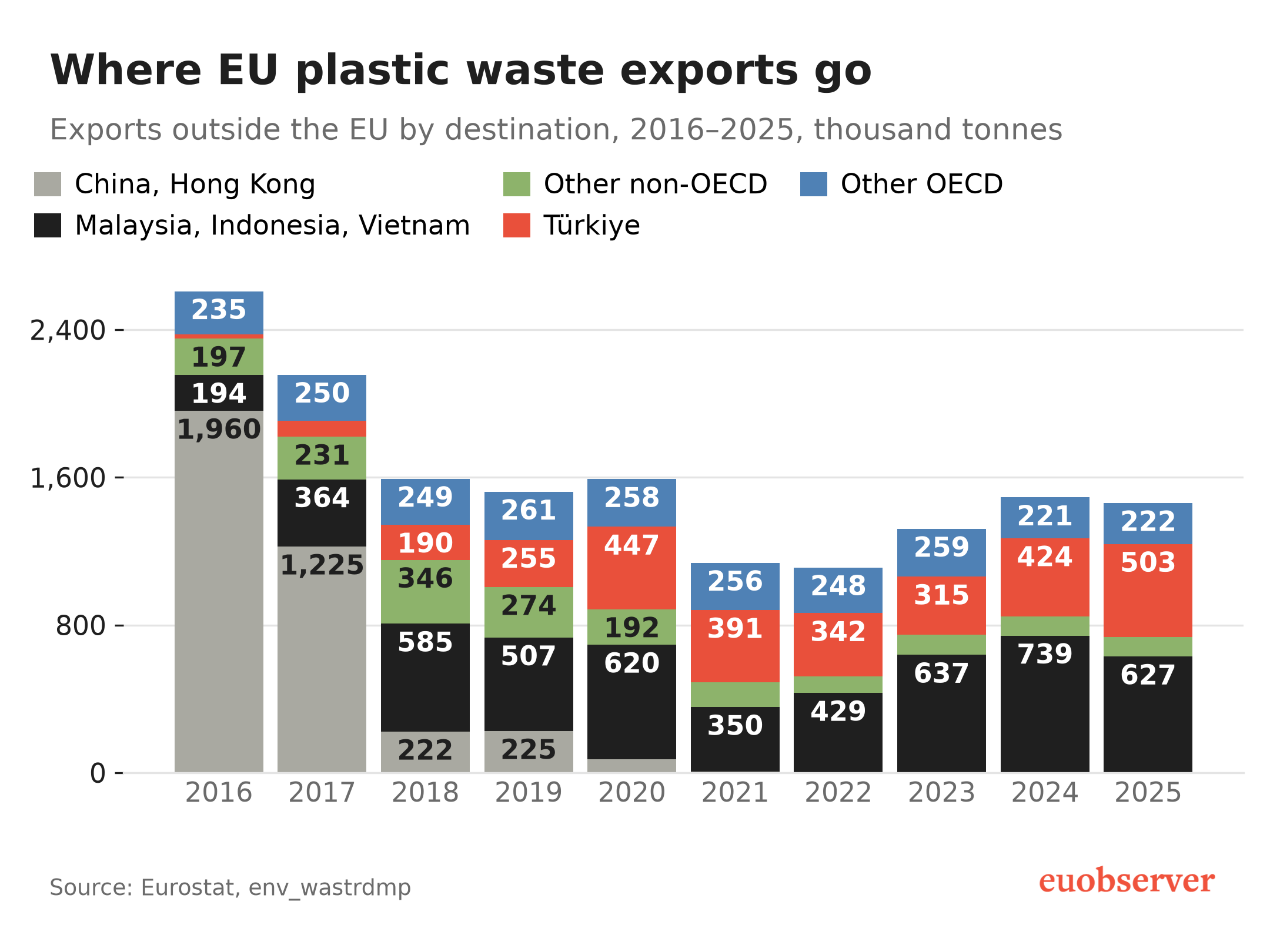
In 2025, non-OECD countries received 735,000 tonnes, around half of the 1.46 million tonnes of plastic waste the EU exported outside the bloc.
Turkey, the EU’s largest OECD destination for plastic waste, could absorb much of this redirected volume.
However, environmental groups such as the Environmental Investigation Agency (EIA) have raised concerns about the country’s waste management and enforcement, questioning whether it should continue receiving EU plastic waste.
The commission itself expects “a shift in destination countries”: part of the waste will find its way into EU recovery capacity, while “a certain amount will be diverted to treatment in OECD countries outside the EU,” a commission spokesperson said.
So, when November ends, where will Europe’s plastic waste go?
A ban with a waiting list
No non-OECD country will receive EU plastic waste for at least two and a half years.
From May 2029, under the Waste Shipment Regulation, countries can apply to resume imports if the commission is satisfied they can manage it sustainably.
Exports to OECD countries remain legal but are subject to stricter controls. Since 21 May 2026, all plastic waste exports to third countries have required prior notification and consent, processed through the EU’s Digital Waste Shipment System (DIWASS).
The next step comes in May 2027, when exporters will also have to demonstrate that destination facilities have passed independent audits.
China and Hong Kong received around three-quarters of Europe’s plastic waste exports in 2016, before Beijing’s import ban pushed shipments towards Malaysia, Indonesia, Vietnam and Turkey. Of these, only Turkey will still be able to receive EU plastic waste after 21 November 2026.
Can Turkey safely manage Europe’s plastic waste?
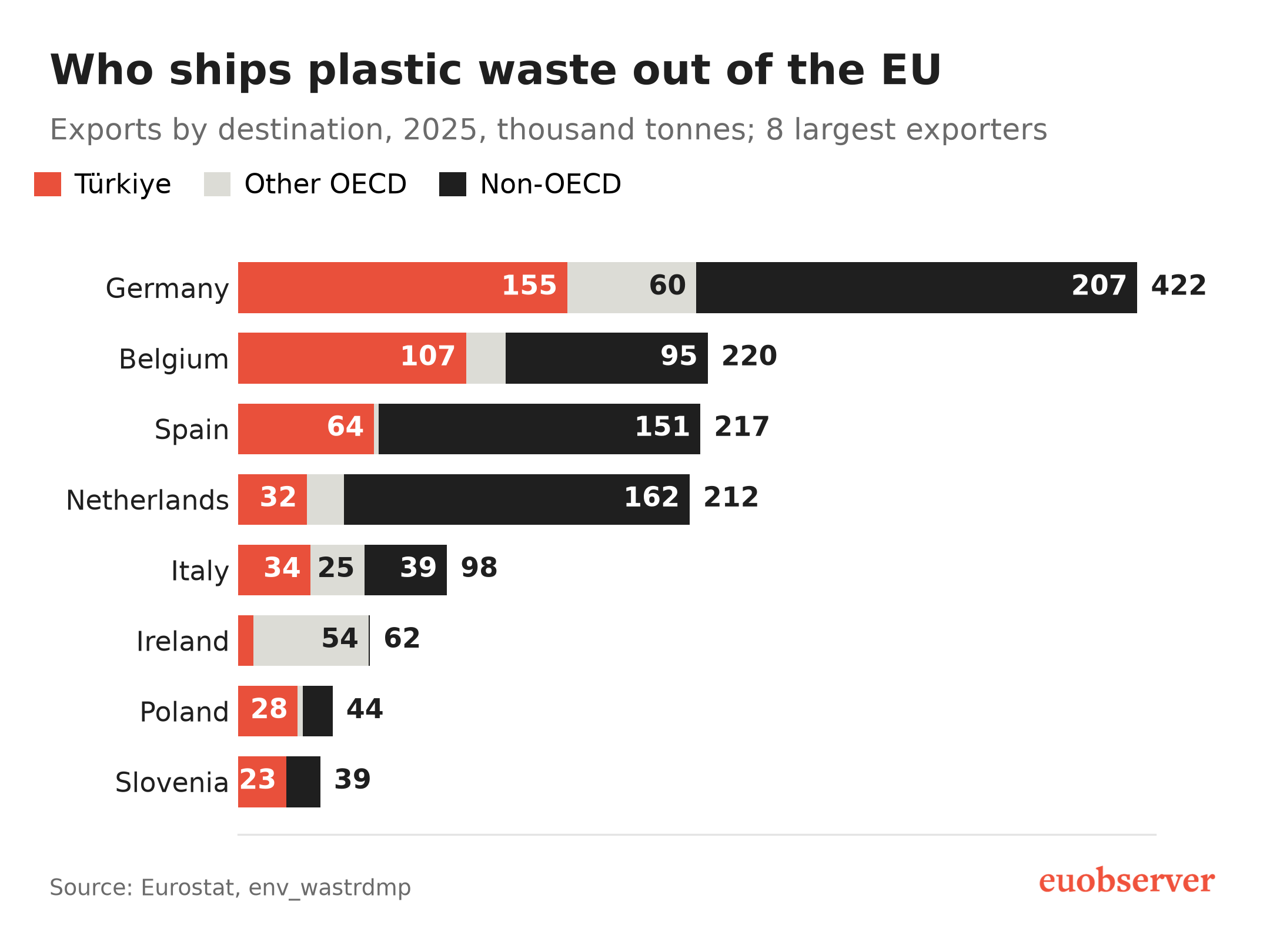
Turkey was the EU’s largest single destination for plastic waste in 2025, receiving 503,000 tonnes, mostly from Germany (155,000) and Belgium (107,000). Both also rely on markets that close in November: Germany sent almost half of its plastic waste exports outside the EU to non-OECD countries, and Belgium 43 percent. Spain and the Netherlands, also among Turkey’s top suppliers, are even more exposed to the November ban, at 70 and 77 percent.
The commission’s assessment of Turkey, published on 18 September, acknowledged that Ankara had strengthened its import controls but highlighted a “lack of transparency” in waste data, insufficient information on enforcement and unclear governance.
The commission nevertheless kept exports open, while pledging to continue monitoring the situation.
Lauren Weir, Senior Campaigner at the EIA, sees a gap: “We think that there’s a disconnect between the commission’s application of the regulation and what that regulation actually says needs to happen.”
“It should not happen, but given the conclusions of this recent commission assessment, it may in the short term,” she said.
In Adana, where around 60 percent of imported plastic waste is processed, researchers found up to 132 times more microplastics in irrigation canals downstream of recycling plants than upstream.
Fires are another warning sign. Blazes at recycling facilities rose from six a year in 2017 to 125 a year in 2022, according to a policy brief by Sedat Gündoğdu, a marine biologist at Adana’s Çukurova University.
“All the fires are happening behind the facilities in storage parts, not the machinery or office parts,” he said.
Turkey caps each facility’s imports at 50 percent of its certified annual processing capacity, according to the commission’s assessment.
But Gündoğdu claims the capacity figures can easily be manipulated. “You can enlarge your area by fencing some places for storage. That’s all,” he explained.
Audits may not close the gap. In 2021, a German inspector found that 2BPlast, a recycling plant in Düzce certified to receive German packaging waste, had been dismantled months earlier while shipments kept arriving.
“Everything will be based on papers. But the real extent of this business is handshaking business. All things are happening behind the doors,” Gündoğdu warned. If independent auditors start inspecting Turkish plants from May 2027, he expects few to succeed: “I don’t believe that more than 10 percent of the facilities can pass this auditing process.”
Turkey already generates around 3.3 million tonnes of plastic waste a year. The government says it recovers 30 percent of its municipal waste, but World Bank data puts the figure at 11.9 percent, according to Gündoğdu’s policy brief.
“How can this country soundly manage waste that belongs to other countries? This is pollution transfer,” Gündoğdu said.