



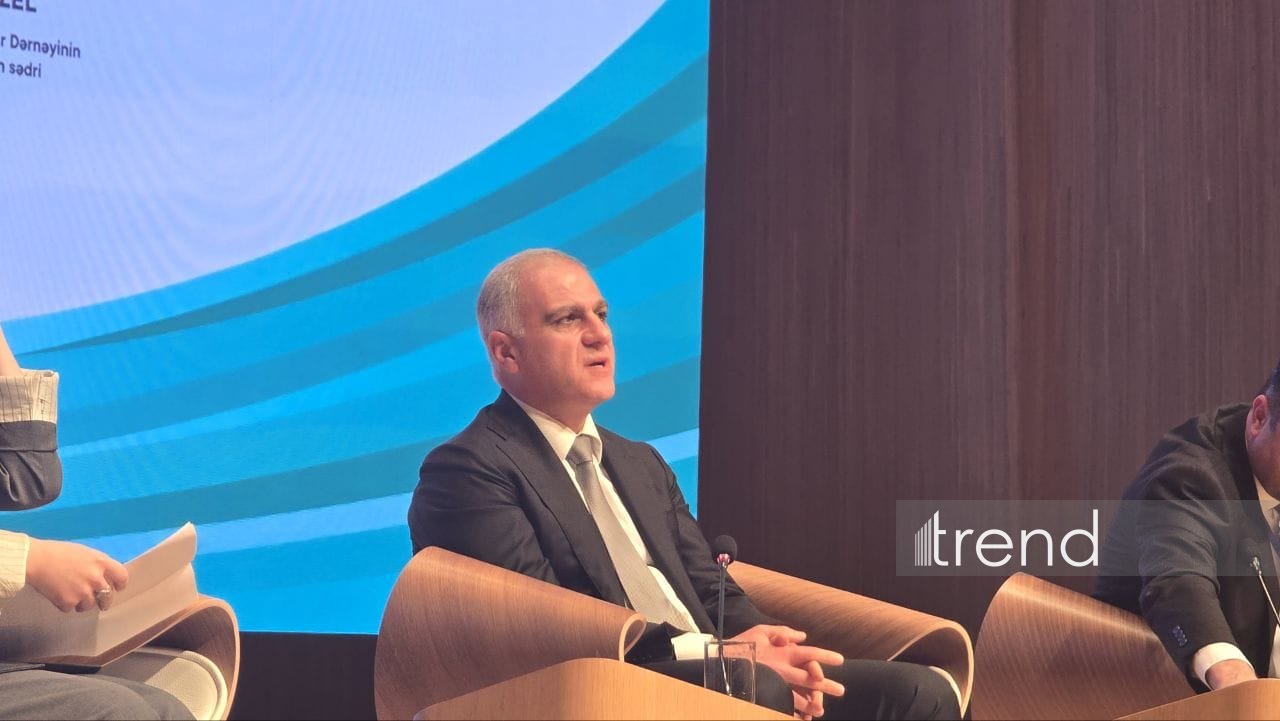
BAKU, Azerbaijan, September
25. The volume of Azerbaijan’s transit freight
transportation is expected to exceed 16 million tons in 2026,
Deputy Minister of Digital Development and Transport Rahman
Hummatov said at the 2nd Azerbaijan International Investment Forum
held in Baku today, Trend‘s correspondent reports from the event.
He noted that currently, the key issue in the transport sector
is not merely establishing sufficient transport capacity, but also
creating alternative connections, diversified supply chains, and
routes that ensure the uninterrupted and reliable movement of cargo
under changing conditions—including during periods of geopolitical
shifts.
“In this context, the Middle Corridor has demonstrated its
resilience and stability compared to other transport routes. The
corridor offers a reliable alternative for maintaining East-West
connectivity,” the deputy minister explained.
According to Hummatov, although the strategic importance of the
Middle Corridor has become more apparent in recent years,
Azerbaijan recognized the significance of this route much
earlier.
“Situated at the crossroads of Europe and Asia, Azerbaijan holds
a strategic position at the heart of the Middle Corridor. Our
commitment to the Europe-Caucasus-Asia transport corridor dates
back decades. The TRACECA Summit held in Baku in 1998 established a
vital framework for regional transport cooperation,” he added.
The deputy minister also said that Azerbaijan is adopting a
comprehensive approach to the development of the corridor, focusing
on both physical and “soft” infrastructure.
According to him, this approach is reflected in investments made
in major infrastructure projects such as the Baku-Tbilisi-Kars
railway, the Baku International Sea Trade Port, and the
Horadiz-Aghband railway, which is currently under construction.
“These projects are the key pillars of the Middle Corridor.
Building upon this transport infrastructure, we are also shaping a
broader logistics and economic ecosystem around Alat. The new Alat
Cargo Airport will further strengthen Alat’s multimodal
connectivity by adding an air cargo component and will support the
development of the Alat Free Economic Zone,” Hummatov
announced.
He stressed that Azerbaijan’s goal isn’t limited to merely being
a transit country.
“A broader approach will enable the integration of transport
links with logistics, trade, manufacturing, and investments,
allowing Azerbaijan to transform into a wider economic hub,” the
deputy minister noted.
Hummatov pointed out that the comprehensive approach being
implemented is already yielding concrete results. According to him,
the volume of Azerbaijan’s transit trade has increased
significantly in recent years.
“We expect our transit trade to exceed 16 million tons in 2026.
This is approximately three times the figure recorded in 2019,
prior to the pandemic,” he said.
The deputy minister noted that cargo transportation along the
Middle Corridor is also set to increase.
According to him, the volume of cargo transported via the Middle
Corridor is expected to reach approximately 5.5 million tons by
2026, while the number of regular container trains originating from
China is projected to rise to around 600.
He added that, based on forecasts by international
organizations, the volume of cargo transported along the Middle
Corridor could reach approximately 11 million tons, and container
transit could hit 900,000 TEUs annually by 2030.
Hummatov further said that Azerbaijan is expanding both the
geographical reach and the throughput capacity of the Middle
Corridor.
“The Washington Joint Declaration, which established the
framework for the TRIPP connectivity project, has given fresh
momentum to this process. Once operational, this link will serve as
a complementary route within the Middle Corridor, creating
opportunities for up to 15 million tons of additional trade
annually,” he noted.
The deputy minister emphasized that completing key
infrastructure projects in other sections of the corridor is
essential to realizing the full potential of these new
connections.
According to him, the Kars-Dilucu railway in Türkiye will
strengthen links toward Europe by extending the Zangezur
connection. Meanwhile, in the east, the China-Kyrgyzstan-Uzbekistan
railway will reinforce rail connectivity between China and Central
Asia.
“Together, these projects will contribute to the creation of a
more integrated, diversified, and resilient East-West transport
network,” Hummatov noted.
He pointed out that the Middle Corridor is now entering a new
phase characterized by the planning and completion of major
infrastructure projects. In addition, the deputy minister
emphasized the importance of strengthening “soft” infrastructure to
enhance the corridor’s efficiency.
“To translate infrastructure capabilities into faster and more
predictable cargo movement, we must also strengthen the corridor’s
soft infrastructure. Reliability, transit times, transparent
pricing policies, and accountability across the entire route are
equally important,” he said.
Hummatov noted that Azerbaijan’s digital “single window”
system—which is already operational and undergoing phased
expansion—integrates key transport, trade, and transit
services.
According to him, this system helps reduce delays and increase
efficiency. However, fully realizing these capabilities requires
ensuring similar developments and better coordination of processes
across all countries along the Middle Corridor.
“Infrastructure development, transport schedules, border
procedures, and information exchange must advance in a coordinated
manner. Progress achieved in one section of the corridor must be
accompanied by corresponding improvements in other sections,” the
deputy minister noted.
Hummatov said that one of the practical steps taken in this
direction was the establishment of a multimodal joint venture along
the Middle Corridor, bringing together the railway operators of
Azerbaijan, Kazakhstan, and Georgia. China subsequently joined this
cooperation as well.
“Today, we are taking this cooperation a step further and
working on a new multilateral initiative.” “The goal is to
establish a stronger, high-level institutional cooperation
framework and to improve coordination among the participating
countries,” he said.
The deputy minister noted that the primary objective for the
period ahead is to transform the Middle Corridor into a more
efficient, predictable, and competitive route.
“Our cooperation can ensure turning the Middle Corridor into a
long-term, reliable East-West trade and logistics platform
connecting Asia and Europe,” Hummatov emphasized.