



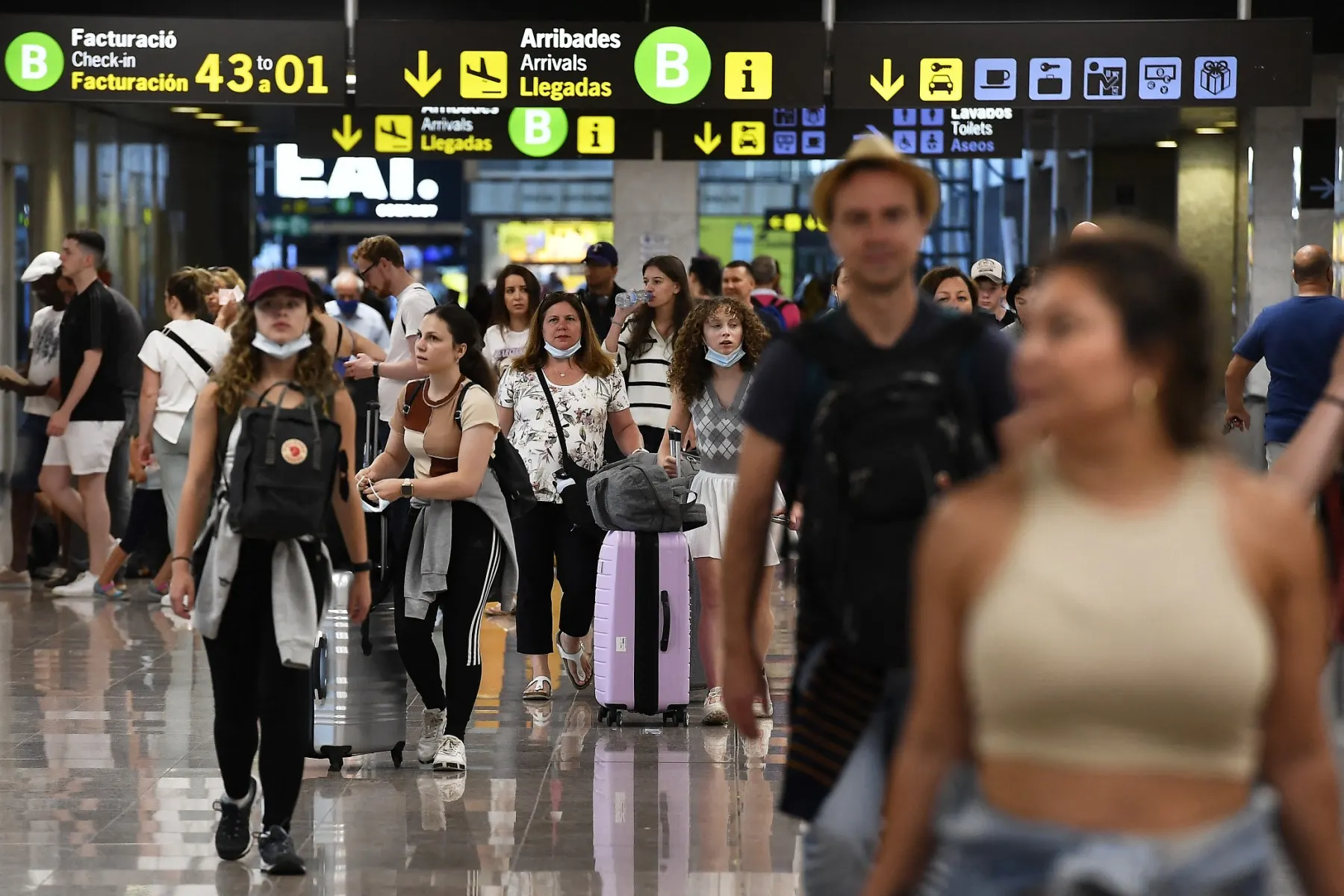
Amid new border rules and record tourism levels, Spain’s state operator is planning to limit air passengers at peak times in order to ensure long-term capacity and infrastructure demands.
Madrid and Barcelona airports are set to partially cap passenger numbers in 2027 ahead of planned renovations at Spain’s two major air travel hubs.
The limits would be on arrivals terminals during the summer season, meaning that passenger flows can be better optimised at peak hours.
This comes as the country’s two largest airports, Madrid-Barajas and Barcelona-El Prat, are nearing their capacity and terminals can no longer keep up with the growing number of seats being offered by airlines.
Madrid-Barajas received some 68.18 million passengers last year, out of a capacity of 70 million, whilst El Prat exceeded its capacity limit of 55 million, serving 57.5 million passengers in 2025.
READ ALSO: How Spain’s Balearics plan to curb overtourism with flight limits
Pressure is particularly acute during summer peak periods and Spain’s airport operator, Aena, is now taking action to prevent gridlock whilst carrying out the long-awaited expansion works to boost capacity overall.
Both airports are awaiting the approval in September by Spain’s Council of Ministers to get their projects underway.
At Madrid Airport, works worth €2.4 billion are planned, including the integration of Terminals 1, 2 and 3 and the expansion of T4 and T4 Satellite, as well as runway works. The aim is to increase the current capacity from 70 million passengers to 90 million, rising from 100 operations per hour to a maximum of 120.
In Barcelona, the expansion works are budgeted at €3.2 billion and will include the construction of a satellite terminal to relieve congestion at T1.
Passenger capacity will increase from 55 million to 80 million, with the Catalan airport able to handle 90 operations per hour compared to the current 78.
Currently Madrid-Barajas can handle up to 100 operations (take-offs and landings) per hour, whilst El Prat can manage up to 78.
This comes amid a boom in tourism in Spain. Aena has seen passenger numbers jump from 275 million in 2019 to a record 321.6 million in 2025, exceeding its targets.
This is the first time that Aena has imposed any kind of cap on passenger growth, however, apart from a one-off instance at Alicante-Elche involving British passengers.
In terms of Madrid and Barcelona, both airports still have some spare capacity during off-peak hours, a margin that Aena intends to utilise by changing its capacity allocation system from the 2027 summer season onwards.
The operator, which reports to the Ministry of Transport, is set to present a plan that breaks down capacity by terminal, time slot and flight type, meaning that the operational margin of runways will no longer be the sole factor in the allocation process.
The major construction works at both Barajas and El Prat will coincide with continued rising air traffic, and Aena is seeking to ensure that passenger volumes and traffic patterns are aligned with infrastructure capacity.
This has been described in the Spanish press as a “defensive strategy”, which Aena sources admit “may somewhat hamper growth in order to ensure operational quality” in the long-term.
Furthermore, Aena has not ruled out applying similar passenger caps at peak times at other congested and developing airports, such as Málaga and Tenerife South.
During a pilot scheme in 2025, the arrival terminal at Alicante Airport had to restrict British passenger flows due to the added complexity of passengers having to present their passports as a result of Brexit.
Then there is the ongoing confusion and delays surrounding the new EES biometric border checks further congesting Spanish airports during peak summer travel.
EES is the EU’s new Entry/Exit System that came into effect on October 12th 2025. Madrid was the first Spanish airport to implement it, followed by other airports.
The idea is to collect biometric data from non-resident, non-EU passengers by using special machines which take passengers’ fingerprints and photos, among other information.
Since EES was first rolled out in Spain, readers of The Local have reported some technical issues, long queues and delays, although in many cases the system appears to be working smoothly.
READ ALSO: What will happen with EES passport checks this summer in Spain?