



This Memorial Day, The Cipher Brief is remembering the Americans who answered the call after Russia launched its unprovoked, deadly invasion of Ukraine in February of 2022. What follows is a deeply personal account of the war through the eyes of two Americans who have lived it. This piece was written by Dr. Douglas Davis in cooperation with Colonel Sam Hartwell (Ret.).
PERSPECTIVE / OPINION – I did not set out to become someone who counts or names the dead. But years of working in Ukraine have a way of reorienting what you thought your life was all about. Our families have a high price dating back to 2014, when Russia invaded Crimea and uprising in the Donbas.
My wife’s 25-year-old cousin, Mykola Zabavchuk, was killed while serving as a sniper near Bakhmut in the first summer of Russia’s invasion. We visit his grave and the memorial bearing his posthumous Order of Courage medal from Ukrainian President Volodymyr Zelensky every time we’re in Lviv. It changes you and keeps a solemn perspective on those who are fighting for their freedom.
But the reality is that the loss of Ukrainian lives is tragic but understood, even expected, in the cold calculus of this war. But that’s not the whole story. What we find most difficult to reconcile is this: America says it is not at war in Ukraine – and officially that’s true – yet some of America’s most experienced warriors cannot ignore the call to defend freedom and have volunteered to fight and die there. Very few outside their military community are talking about it.
My collaborator for this article, Sam Hartwell is a West Point graduate and former U.S. Army intelligence officer who has spent much of the past three decades living and working in Ukraine. He knows what I am talking about better than most. He lost one of his closest friends, Mark Paslawsky, a West Point classmate and former 82nd Airborne Division artillery officer on August 19, 2014, in Donbas.
Paslawsky was the first American killed in Russia’s war on Ukraine at the Battle of Ilovaisk. He was posthumously awarded the Order of Danylo Halytsky by then-Ukrainian President Petro Poroshenko. Sam now lives in his friend’s former apartment in Kyiv, not far from a memorial wall that bears Mark’s portrait. Sam does not talk about this often. That restraint is itself, a kind of testimony.
As a global health physician, I came to this story through a different door than Sam did. My medical work in Ukraine brought me into close contact with a remarkable and unlikely community: American veterans who came to Ukraine not under orders, not under contract, but under conscience. Many applied the lessons learned in war and national security to fight for freedom alongside Ukrainian brothers and sisters in arms. Others came principally to support humanitarian causes.
Crisis of Conscience
I had the honor of serving on the board of one such humanitarian group, Mountain Seed Foundation, alongside its founder, Lieutenant Colonel Nathan Schmidt, USMC ret., and Navy SEAL Lieutenant Commander Dan Cnossen, USN ret., two Naval Academy classmates whose service in Iraq and Afghanistan, respectively, left marks that never fully heal.
Nathan’s wounds are the kind that don’t show up in physical exams. He came home carrying the weight and burden of friends and colleagues who were lost both above and below his command, and he built something redemptive from that grief.
Dan’s injuries were immediate and visible: both of his legs were taken above the knee by an IED during combat operations. He went on to become one of the most decorated American Winter Paralympians of his generation.
Two different kinds of loss. Two extraordinary responses to it.
Together we have climbed mountains in the Austrian Alps and the Carpathians of Ukraine with Ukrainian veterans and their families, part of a healing process that I will admit freely, has been as transformative for me as for anyone on those steep slopes and ledges. Nathan and Dan are two of the finest human beings I have encountered in my life, and they represent something larger: the remarkable community of similarly extraordinary American veterans who have quietly extended their service into the humanitarian domain long after their official obligations ended.
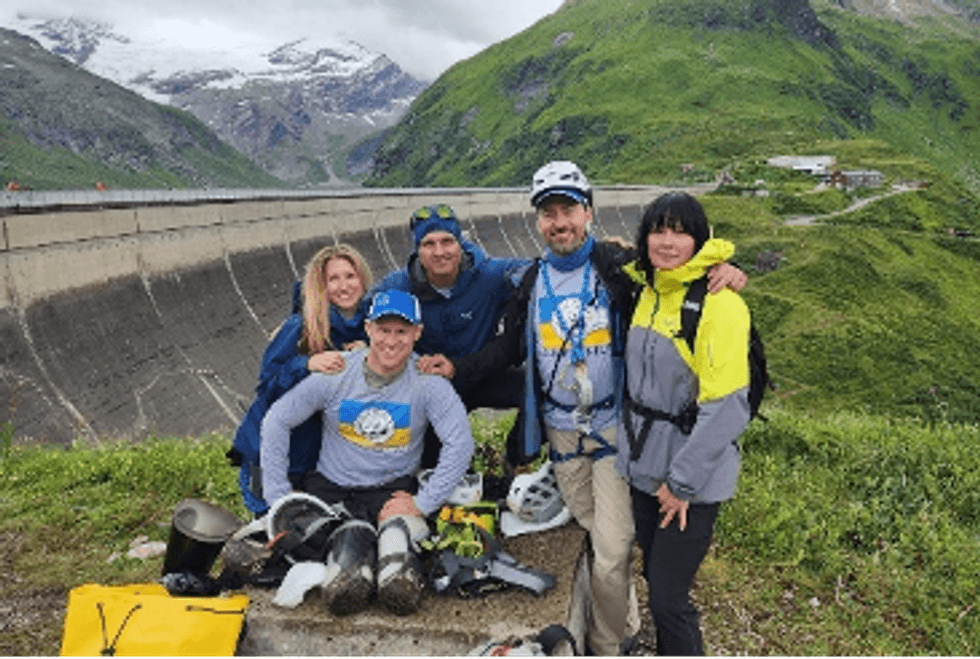 “Kaprun, Austria at the Mooserboden Dam in Hohe Tauern National Park in Summer 2023. Mountain Seed Foundation ‘climbing to heal’ alongside veterans and Ukrainian Gold Star families in the Austrian Alps. Pictured (left to right): Volunteer Courtney Brilliant, Davis, Lt Commander Dan Cnossen, Lt Colonel Nathan Schmidt, Dr. Davis, MSF co-founder Iryna Prykhodko.” Photo provided by Dr. Davis.
“Kaprun, Austria at the Mooserboden Dam in Hohe Tauern National Park in Summer 2023. Mountain Seed Foundation ‘climbing to heal’ alongside veterans and Ukrainian Gold Star families in the Austrian Alps. Pictured (left to right): Volunteer Courtney Brilliant, Davis, Lt Commander Dan Cnossen, Lt Colonel Nathan Schmidt, Dr. Davis, MSF co-founder Iryna Prykhodko.”
I have also encountered American warfighters who, like Sam’s friend Mark, resolved their crisis of conscience over this war by making it their own. Individuals like Bryan Pickens, a twenty-year Special Forces (SF) veteran, left retirement not for a contractor’s paycheck but to volunteer to lead a combat and drone team of former US. .Special Operations Forces (SOF) operating in active fighting and training. With Russian language skills and extensive combat experience, Bryan first came to Ukraine in 2019 while still in uniform as an official adviser with U.S. Army Special Forces. He later retired and returned to Ukraine in 2022 as a volunteer. He has not looked back.
The men around him are cut from the same cloth. Xen is an accomplished Navy SEAL veteran, sniper and Ukraine drone pilot who brings to this fight the quiet, fierce conviction that defines the best of that community. Bryan, Xen, and others from their circle first came into my life to provide security for me and my colleagues when our humanitarian work brought us into proximity to the front lines. That practical necessity became something else over time. The relationships deepened into a kind of mutual mentorship, each of us coming to understand this war through the other’s eyes, and my admiration for all of them has only grown. We have since written and spoken publicly together trying to convey the urgency of what is happening and to close the gaps in understanding that still persist in Washington and beyond.
Joshua Ransford, a former U.S. Marine and another member of Bryan’s team, traces a similar arc. He has been working in Ukraine since early 2022, starting as infantry, reconnaissance, and a sniper before evolving into drone operations as the battlefield transformed into an environment where unmanned systems became decisive. He has led counter-electronic warfare and security for our medical teams, including in situations where we found ourselves amid active drone and missile strikes.
What he, Bryan, Xen and others have taught me about the realities of modern war – far beyond anything the medical spectrum captures – is profound. I may never find the right forum to share all of it. But this account of what’s really happening would not exist without Joshua and the other veteran combatants who have trusted me with what they know. As the conflict with Iran has made clear, the lessons carried by this community are not abstractions. They are operational intelligence that the United States cannot afford to ignore.
The Cost of Showing Up
First of all, let me be clear about what these veterans are and what they are not. They are not mercenaries. They are not reckless adventurers seeking a second act or a story to tell. They are among the most disciplined, experienced, and morally serious people I have ever known, and the war has not made them harder so much as it has made them more clear on the realities that exist. They did not ask to be named or recognized. Those whom Sam and I identify in this account acquiesced to sharing their stories only after persuasion that sharing serves a larger cause. They are unsung American heroes operating in Ukraine as often unpaid, largely unsupported volunteers, at enormous personal risk and at real cost to their lives back home.
That last point deserves a moment of reflection. Veteran volunteers like Bryan Pickens have had to periodically leave Ukraine entirely, return stateside, and take contract work simply to finance their ability to go back. The war does not pause while they earn the money to fight it as volunteers. Nor do their mortgages and other obligations at home.
Incidentally, some readers may recognize Bryan in a different context: he served as a military adviser and a role player alongside Sean Penn in the Oscar-winning film One Battle After Another.
The title is unintentionally poetic. Bryan moves back and forth between that work stateside and a calling that keeps pulling him back to the Ukrainian front. I learned this only after the film debuted, from Bryan’s teammates — because self-promotion is not in his DNA, almost to a fault. That is the reality for many of these veterans. Little to no salary. No benefits. No official recognition. Just the conviction that the work matters and the discipline to keep showing up for it. One. Battle. After. Another.
That is no small thing. In a moment when official policy has struggled to match the clarity of the moral stakes, these individuals have provided their own answer. For too many of them, that answer has been written in blood, and paid for with their lives.
In February of 2023, Pete Reed, a former U.S. Marine and seasoned humanitarian worker, was killed in Bakhmut. The New York Times documented his death in detail, as it was caught on film. I knew Pete through the overlapping networks of American volunteers and veterans working in Ukraine, and I arrived in Lviv for one of my early trips of this war on the very day he died. His loss hit his community hard. What the coverage captured was the human cost. What it did not fully capture was an emerging pattern.
Detecting a Quiet Pattern
I began to see that pattern first through Pete, and more so later as I became drawn into the care coordination of several international veterans wounded in Ukraine. Among them was an American Marine veteran named Cristiano Zeledon, who was working in a humanitarian capacity when he was severely wounded in a missile strike on a pizzeria in Kramatorsk in June 2023. That same strike killed several other aid workers, including the celebrated Ukrainian writer and war crimes researcher Victoria Amelina, whose death drew significant international attention and outrage. It also killed American veteran Ian Tortorici, who had been serving in combat with the Ukrainian International Legion.
What the coverage at the time did not report, and what was suggested to those of us working in these networks afterward, is this: a Russian intelligence asset had been monitoring not just the foreign aid workers who were killed in that pizzeria, but specifically, American veterans and they called in the strike to kill them. If true, then this was not just a random act of war. It was a targeted assassination of Americans on foreign soil, planned and executed opportunistically by Russian intelligence.
The attack barely registered in the West, in part because the public visibility of American involvement in Ukraine was being carefully managed as Washington sought to avoid any appearance of escalation. One can also blame the saturated news cycle, which moves rapidly from one atrocity to the next, leaving yesterday’s events forgotten before they are fully understood.
It should have registered. Because that strike was not an isolated incident. It was another data point in a pattern the American public has not yet been compelled to reckon with. People like Bryan Pickens and his community helped me see it more clearly and soberly.
Rocki, Tiny & Sandy
That pattern is perhaps best exemplified by retired U.S. Marine First Sergeant Corey Nawrocki, widely recognized as one of the most decorated Americans killed while defending Ukraine. Nawrocki, known as “Rocki” was operating alongside other American veterans when he died in October 2024.
I met an experienced combat operator and medic who goes by the callsign “Tiny” at a medical conference in Kyiv, where his frontline experience helped shape our discussions on the evolving realities of combat casualty care. He later shared the details of Corey’s death on the condition of anonymity for security reasons.
Tiny was the primary medic on the mission. When the team crossed into Bryansk, Russia on a sabotage and reconnaissance operation under the direction of Ukrainian Military Intelligence, they encountered a large Russian force. In the firefight that ensued, Tiny was treating a teammate with a gunshot wound to the head when he himself was wounded and evacuated by ATV to a hospital in Semenivka, Ukraine. Corey died courageously and selflessly under heavy fire while attempting to rescue another wounded teammate. The details of his final hours that Tiny shared with me remain among the most sobering things I have encountered in years of working in this war. Tiny shared the account of the battle and of Corey’s final moments, which has been corroborated by recordings and testimony from other teammates. I am haunted by what he showed me.
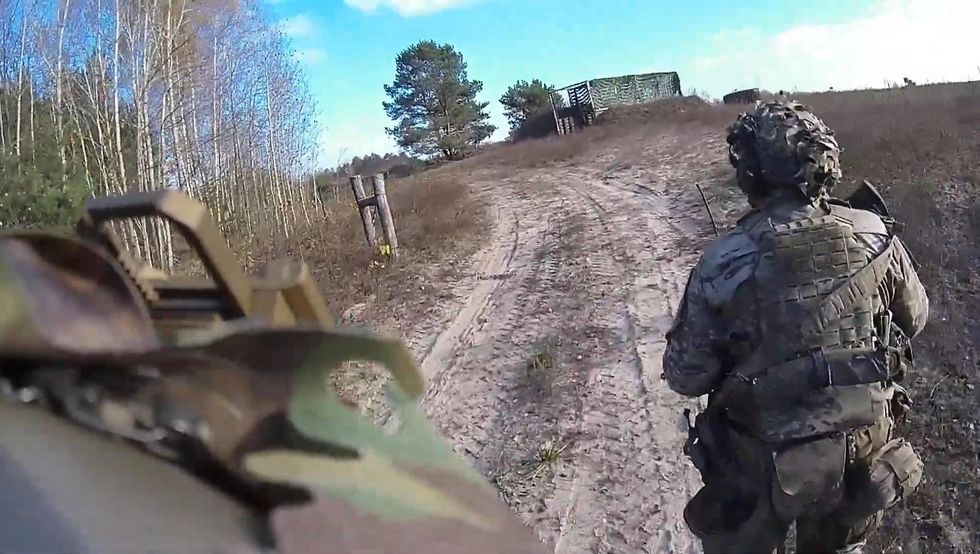 Corey approaches a Russian position during a raid into Bryansk Oblast, Russia. Photos provided by Sandy Nawrocki with permission to publish.
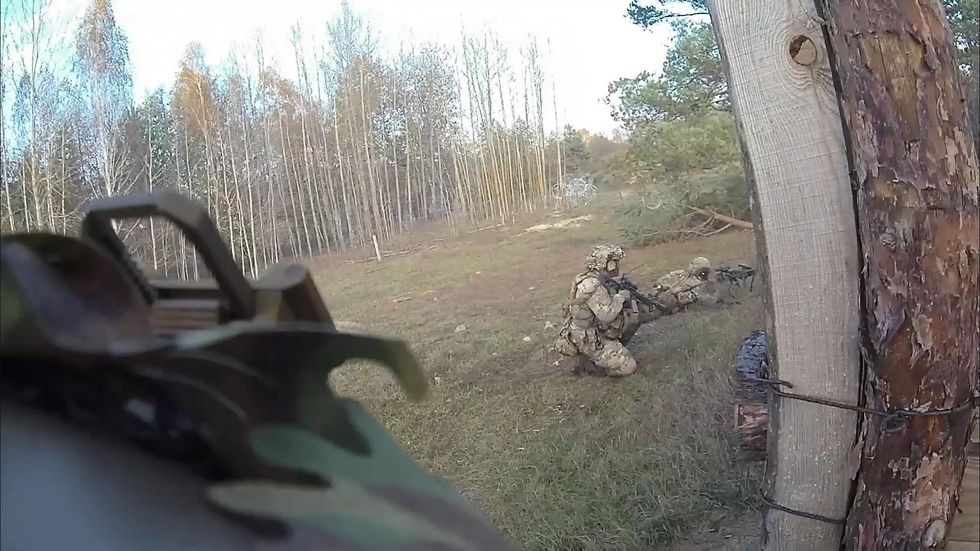 Corey and teammate during a raid into Bryansk Oblast, Russia. Photos provided by Sandy Nawrocki with permission to publish.
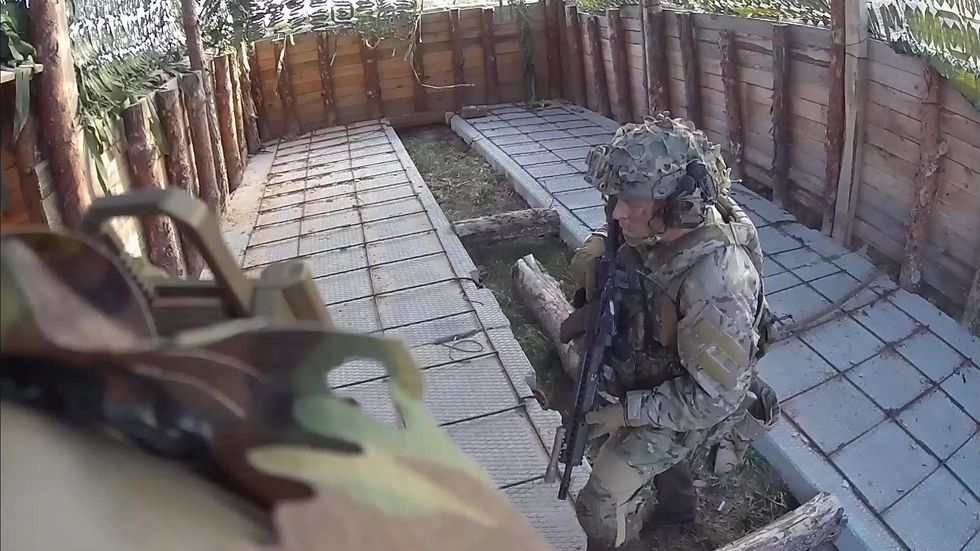 Corey Nawrocki, during the raid into Bryansk Oblast, Russia, one of the last images of him alive. Nawrocki, a U.S. Marine Corps veteran and two-time Purple Heart recipient, was killed on October 27, 2024, during the operation while attempting to rescue a wounded teammate. Photos provided by Sandy Nawrocki with permission to use.
But death was not the end of it. Indignity followed. Russian soldiers stood over Nawrocki’s body, displayed his military ID, and broadcast the image to the world. A distinguished Marine Corps veteran, reduced to a trophy. His identity paraded before a global audience while his family was still learning what had happened. And it did not stop there.
Following his death, Corey’s mother, Sandy Nawrocki, says she was the target of a deliberate digital campaign of cruelty. In a CNN interview, she described being targeted online after Corey’s death, saying trolls posted a picture of her home and her full address, and in an act that can only be described as calculated brutality, posted smiling emojis on social media posts about Corey. Sandy has also spoken publicly, including at a Congressional Ukraine Caucus press conference, about her son’s sacrifice and the broader toll on American families whose loved ones have fought for Ukraine.
The haunting we already felt only intensified after conversations with Sandy, who faced not only the unimaginable grief of losing her son and the torment of a malicious Russian campaign against her, but a separate and frustrating battle to bring Corey’s body home and secure him a military burial at Arlington National Cemetery. That is a struggle that never should have happened. It tells you something important about how this country has chosen to account for its sons in Ukraine’s war. But stories like these have barely registered in the American news cycle.
Corey was killed alongside three other international volunteers: U.S. veteran Bradley Jennison, known as “Super Dave,” Canadian Mandeep Singh, known as “Poet,” and Swedish volunteer Simon Rajakisto, known as “Rauta.” These were men who showed up to fight for what they believed in, an ad hoc coalition of Western veterans operating without formal government acknowledgment or protection. That is what makes the repatriation difficult and the propaganda exploitation of their bodies so damning.
Corey’s name appears on no official list of American soldier casualties in Ukraine. America has no such list for a war it is not officially fighting. Corey is, in the ledger of this conflict, ambiguous — if not invisible. That ledger is difficult to reconcile, and the numbers we can piece together paint a sobering picture, even if they remain only an approximation of the truth.
The Invisible Ledger
Since February 2022, the United States has officially lost no active-duty service members in Ukraine. That is technically true. What it obscures is something that those of us working on the ground have understood for years: a significant number of America’s most elite veterans, including Special Forces, SOF, and similar warfighters, have gone to Ukraine as civilians and have not come home. The New York Times reported at least 92 American veterans killed in action in Ukraine as of September 2025, but many within the community believe the true number is much higher. Online (and unofficial) estimates suggest elite American veteran deaths since 2022 fall somewhere between 100 and 150, and possibly more. No official U.S. entity is keeping count. Because none of them were officially there.
To put that figure in context: the total number of U.S. Special Operators killed across the entire two-decade global war on terror is reported in the low 600s . If current estimates from Ukraine are even close to accurate, the annual rate of loss among American SOF veterans in Ukraine is near or exceeds the per-year casualty rate of the entire war on terror. Read that again. In a war the United States is officially not fighting, America’s top war fighters are dying at a pace that rivals the wars we were officially fighting up to our withdrawal from Afghanistan. And if you were to include veterans coming from other NATO-aligned countries, the numbers increase considerably.
To be clear, this is not a comparison between the war on terror and the war in Ukraine. These are fundamentally different conflicts across every meaningful dimension: geography, doctrine, technology, and geopolitical stakes. Nor is it a comparison between special operators and conventional warfighters. The point is not equivalence. The point is scale, motivation, and the character of the men and women who are making the sacrifice.
A Verdict, Not an Accident
These are not green volunteers swept up in idealism. These are the most capable, most experienced, most thoroughly trained fighters the United States and NATO has ever produced. They have seen war up close. They understand the odds. They are making a deliberate choice, with no orders, little to no salary, no benefits, no official recognition, and no government waiting to bring their bodies home, to put themselves in the line of fire for a country that is not theirs. That choice deserves to be known and understood by the American public.
But the reality is that the American military and political establishment has largely looked away from this reality, partly for legal and diplomatic reasons, partly because acknowledging it complicates the official narrative of non-involvement, and partly because the men and women doing this work are by training and temperament, disinclined to seek attention. They are called quiet professionals for a reason. They do not hold press conferences. They do not post on social media except to the extent necessary to support their volunteering. They go, they fight, they bleed, and when they do not come back, their families grieve privately while Washington issues no statements. And the American public, by and large, has little to no idea they were ever there.
Sam Hartwell lives inside that grief.
He walks past his friend’s portrait almost daily. He understands in a way that no policy paper can convey, what it means that America’s best are choosing Ukraine. It is not a coincidence or an accident of individual temperament. It’s a verdict.
Sam’s grief is compounded by a particular sorrow that comes not just from personal loss but from watching something he believed in turn away from itself. For soldiers of his generation, witnessing America step back from the principles that have anchored the rules-based international order for nearly a century is professionally and personally devastating in ways that resist easy description. Yet the men we write about here did not abandon those ideals. They did not wait for permission or policy to catch up with their conscience. That is why they came. That is why they stayed.
These veterans have lived and studied warfare and geopolitics at the highest levels. They have operated in every major theater of conflict of the past two to three decades. They have seen what American power can do and what happens when it retreats. They have looked at what is happening in Ukraine with clear eyes and concluded that the stakes are worth dying for. They recognize what a Russian victory would mean for the security architecture of Europe and the world. They understand what it would do to the credibility and readiness of American power at a moment when that credibility is already under strain. They know that the strategic center of gravity for this century is China, and that pressing demands in Latin America, Africa, and the Middle East complicate the math — but that the thread running through this era of great power competition also runs directly through Ukraine. And they understand what hangs in the balance for the rules-based international order that American blood and treasure built across the last century and that is now, for the first time in a generation, genuinely at risk of unraveling.
They are voting with their lives. The least the rest of us can do is count the votes honestly.
The quiet professionals ask for almost nothing except our support. They do not ask to be called heroes, though they are. But the story of what they have given, and what they continue to give, in a war that Washington officially says does not involve American casualties, is one the American people deserve to know. Not to inflame. Not to escalate. But to reckon honestly with what is being sacrificed, by whom, and why.
Pete Reed knew why. Ian Tortoricci knew why. Corey Nawrocki knew why. Sam’s friend Mark Paslawsky knew why. So does every American volunteer in Ukraine, whether they fight or support those fighting for Ukraine’s freedom and Ukraine’s very existence. So does every name on the memorial wall in Kyiv, and on walls like them across the country. Memorials that most Americans will never see. They all answered the question of why – not with words, but with action.
Eyes Wide Open
The question that remains is what to do with this story. Sam and I make no claim that this account is comprehensive. It is not. Others may interpret what we have described differently than we do. But it is a beginning, a handful of names and stories pulled from a much larger ledger that our country has not yet fully reconciled. We offer them here because they deserve to be named, because the silence around them is not neutral, and because meaningful dialogue, honest reckoning, and sound policy can only follow from what we are first willing to see. And that begins with eyes wide open.
Honoring the fallen is not optional. But to honor them without learning what they learned would be a compounding tragedy.
The lessons carried home from Ukraine by some of our most elite veteran volunteers, written in blood on a battlefield that has become the proving ground for modern warfare, are directly applicable to active duty service members in other theaters of conflict and to the new and emerging threats facing our homeland defenders. It would be a disgrace to leave them unexamined.
Ukraine is doing its part to honor and memorialize the foreign veterans who have fallen on its soil. My friend Vitali Ostapchuk, a retired Ukrainian Military Intelligence officer, has dedicated himself almost entirely to this mission. In addition to memorial walls and other honors for international veteran volunteers across the country, Vitali is working to establish a national memorial to fallen American veterans and other international volunteers in Bucha, not far from the mass grave site marking the Russian massacres that were carried out in the early weeks of Moscow’s full-scale invasion. Sam and I fully support Vitali and his colleagues in this endeavor. I have visited Bucha many times to honor Ukraine’s dead. I will have even more reason to return now to honor our own. Sam and I have suggested that they call the memorial “The Quiet Professionals.”
The Cipher Brief is committed to publishing a range of perspectives on national security issues submitted by deeply experienced national security professionals. Opinions expressed are those of the author and do not represent the views or opinions of The Cipher Brief.
Have a perspective to share based on your experience in the national security field? Send it to Editor@thecipherbrief.com for publication consideration.
Read more expert-driven national security insights, perspective and analysis in The Cipher Brief