



The song hit number two on the Billboard Hot 100 in 1963. Not Bob Dylan’s version. Peter, Paul and Mary’s. His own single, recorded July 9, 1962, at Columbia Recording Studio in New York, came and went without the same fire. But that cover, the one managed by Dylan’s own Albert Grossman, sold 300,000 copies in its first week. A million total. Dylan was told he might clear five thousand dollars from publishing. He didn’t say much. Couldn’t.
“Blowin’ in the Wind” is a song about questions that shouldn’t need asking. How many roads before you call a man a man? How many years before people are free? How many deaths before someone notices? The answers, Dylan keeps saying, are blowing in the wind. Right there. We still don’t grab them.
April 16, 1962. Gerde’s Folk City. Dylan stepped up with a two-verse version of something he’d just finished at the Gaslight Cafe that same day. He told the room: “This here ain’t no protest song or anything like that, ’cause I don’t write no protest songs.” Then he played it. The Gaslight, half-underground at 115 MacDougal, had been a horse stable. By 1962 it was the kind of room where folk singers passed a hat and meant it. The Village circuit, Café Wha?, Gerde’s, the Gaslight, worked like a testing ground. You played a song, watched whether people looked up from their coffee. They looked up. But looking up isn’t acting.
Dylan never hid the source. The melody came from No More Auction Block, a nineteenth-century slave song that Alan Lomax traced to Canada, where former slaves fled after Britain abolished slavery in 1833. Dylan told Marc Rowland in 1978: “I took it off a song called ‘No More Auction Block’ that’s a spiritual and ‘Blowin’ in the Wind’ follows the same feeling.” He’d recorded “No More Auction Block” live at the Gaslight in October 1962. It shows up on The Bootleg Series Volumes 1–3. Same bones. Different weather. He didn’t bury the theft. He wore it. The folk tradition, he later said, meant “you use what’s been handed down.”
A white kid from Minnesota pulling from an African American spiritual, then writing a song that Black audiences immediately claimed. Mavis Staples told Martin Scorsese she couldn’t understand how a young white man captured something that raw. Sam Cooke heard it and felt ashamed he hadn’t written it himself.
Then he wrote A Change Is Gonna Come. That song also asks why change takes so long.
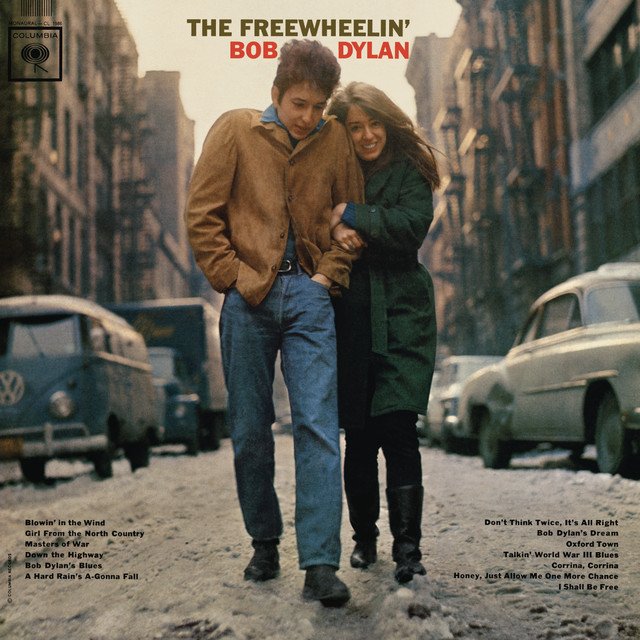
Listen to what Dylan did with the music. Three chords. G, C, D mostly. A child could learn it in an afternoon. A complicated arrangement would have buried the questions. The repetition pushes the same way each verse does. How many roads. How many seas. How many years. How many times. The music never changes because the problem never changes. And that harmonica, the one that sounds like it’s figuring things out in real time, breaks between each question like Dylan is giving you space to answer before he admits he doesn’t have one either. You could play this song on a shipping crate with two strings and it would still land.
November 1963. Newsweek ran a piece suggesting Dylan hadn’t written the song at all. A New Jersey high school student named Lorre Wyatt, a volunteer at the same hospital where Dylan visited Woody Guthrie, had shown off the lyrics from Sing Out! magazine to classmates and claimed authorship. The lie grew legs. Wyatt eventually admitted it was a fabrication. But the rumor stuck for years. Dylan, in a 2012 Rolling Stone interview, shrugged: “Newsweek magazine lit the fuse way back when … So what’s so different? It’s gone on for so long I might not be able to live without it now. F–k ’em. I’ll see them all in their graves.” A song about ignored truths got its own truth questioned. Even the authorship became something floating just out of reach.
The Chad Mitchell Trio recorded “Blowin’ in the Wind” first, four months before Dylan’s studio take. Their label wouldn’t release it because of the word “death” in the lyric. Albert Grossman, Dylan’s manager, saw the opening. He gave it to Peter, Paul and Mary. Clean harmonies. Upright posture. That version went to number two. The Hollies later tried to record a whole album of Dylan covers. Graham Nash walked out when they turned this song into a Nelson Riddle-style swing thing. He called it a hatchet job. You can’t swing your way through a question about cannonballs.
In 1994, the song entered the Grammy Hall of Fame. Rolling Stone later ranked it No. 14 on the 500 Greatest Songs of All Time. The strangest accolade came from Pope John Paul II. At a 1997 church congress in Bologna, the Pope told 300,000 young Italians that the answer was indeed “in the wind.” Not the wind that blows things away, but “the wind that is the breath and life of the Holy Spirit.” He even answered one of Dylan’s lines. “One. There is only one road for man, and it is Christ.” A Pope reducing a song’s open question to a closed answer. Dylan, by then a born-again Christian of the shaggy, complicated sort, just played the song. No comment. The song isn’t about getting a single answer. It’s about why we keep failing to act on the ones we already have.
Read the lyrics cold. “How many ears must one man have before he can hear people cry?” “How many times can a man turn his head and pretend that he just doesn’t see?” That’s aimed at everyone who looked away from Birmingham, from Selma, from every war since. Andy Gill, the critic, put it well. Dylan moved from “the particular to the general.” A song about one injustice ages badly. A song about any injustice just keeps waking up. That’s why the civil rights movement claimed it. That’s why the anti-war movement claimed it. That’s why it still gets rolled out every time someone shoots someone who shouldn’t have been shot.
The original recording sits there. July 1962. A 21-year-old in a studio, acoustic guitar, harmonica rack. Accounts suggest Dylan worked fast, often one or two takes, trusting the first feel rather than perfecting it. He didn’t sound uncertain. He sounded tired. Tired of a world where a man walks down road after road and still has to ask when he’ll be called a man. Tired of a world where “too many people have died” is a line that never stops being current. The answer, he kept saying, is blowing in the wind. Sixty-three years later, it hasn’t landed yet. That’s not the wind’s fault.
You might also like:
Bob Dylan Blowin’ in the Wind Lyrics
Verse 1
How many roads must a man walk down
Before you call him a man?
How many seas must the white dove sail
Before she sleeps in the sand?
Yes, and how many times must the cannonballs fly
Before they’re forever banned?
Refrain
The answer, my friend
Is blowin’ in the wind
The answer is blowin’ in the wind
Verse 2
Yes, and how many years can a mountain exist
Before it is washed to the sea?
Yes, and how many years can some people exist
Before they’re allowed to be free?
Yes, and how many times can a man turn his head
And pretend that he just doesn’t see?
Refrain
The answer, my friend
Is blowin’ in the wind
The answer is blowin’ in the wind
Verse 3
Yes, and how many times must a man look up
Before he can see the sky?
Yes, and how many ears must one man have
Before he can hear people cry?
Yes, and how many deaths will it take till he knows
That too many people have died?
Refrain
The answer, my friend
Is blowin’ in the wind
The answer is blowin’ in the wind