


From time‑traveling stainless steel to talking Trans Ams, these machines became more than props; they became legends. Some defined eras. Some defined genres. All defined fandom.
As Kelley Blue Book celebrates 100 years, we’re looking back at a century of unforgettable cars from pop culture that left their mark on screens and on us.
KITT — “Knight Rider”
The Knight Industries Two Thousand wasn’t just a car; it was a character. Sleek, sarcastic, and nearly indestructible, the modified black 1982 Pontiac Firebird Trans Am quickly became one of TV’s most beloved rides (voiced by William Daniels), especially alongside Michael Knight (played by David Hasselhoff, who later starred in “Baywatch”).
Together, KITT and Knight formed one of television’s most memorable duos. With its futuristic, talking AI, KITT felt way ahead of its time, securing its place as a standout in pop culture.
The DeLorean — “Back to the Future”

As Doc Brown (played by Christopher Lloyd) famously says in “Back to the Future,” “If you’re going to build a time machine into a car, why not do it with some style?” That’s exactly what he did with a 1981 DeLorean DMC-12, turning the stainless steel-bodied coupe with gullwing doors into a futuristic masterpiece with a flux capacitor. The striking design helped drive one of cinema’s most successful trilogies.
Few cars have ever become as instantly recognizable as the “Back to the Future” DeLorean. Once a commercial flop, the car became immortal the moment Doc turned it into a time machine.
The Batmobile — “Batman”
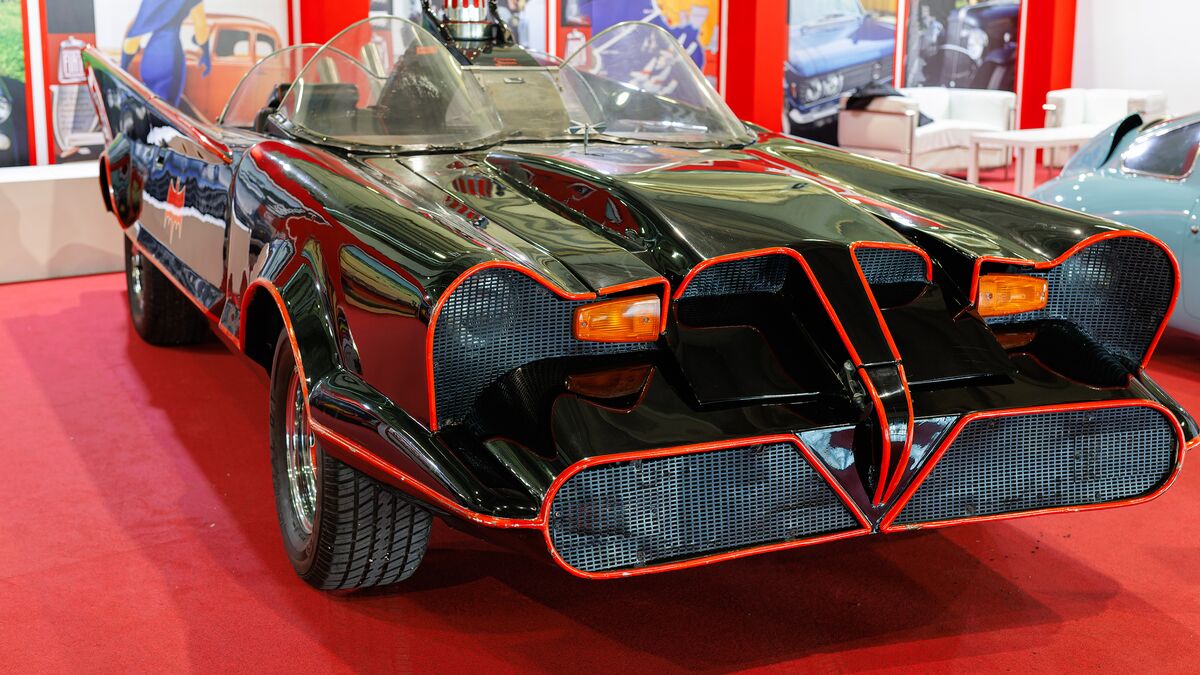
From the quirky 1966 bubble-canopy cruiser to the Tumbler’s tank‑like aggression, the Batmobile has evolved with every generation of Batman. The Batmobile may reflect Batman’s mood and era, but it’s just as shaped by the times that created it; it is less a car and more a cultural mirror, constantly evolving yet always legendary.
ECTO-1 — “Ghostbusters”
Built from a converted 1959 Cadillac Miller-Meteor ambulance, ECTO-1 became one of the most recognizable movie cars ever, with its wailing siren and gear-packed roof rack instantly giving it away.
Even in the face of supernatural chaos, the Ghostbusters still cared about their ride, a feeling echoed by Ghostbusters’ iconic saying, “Who you gonna call? Ghostbusters!” This line helped turn their beat-up ambulance into a full-blown pop culture phenomenon.
Aston Martin DB5 — “Goldfinger”
When James Bond hit the road in his 1964 Aston Martin DB5 in the 1964 film “Goldfinger,” the car became his co‑star, stealing scenes with ejector seats, machine guns, and that unmistakable 007 attitude. It helped shape decades of action‑movie aesthetics and made audiences everywhere believe that the right car could turn anyone into a secret agent with impeccable taste and a license to thrill.
The General Lee — “The Dukes of Hazzard”
The General Lee didn’t just star in “The Dukes of Hazzard” for seven seasons from 1979 to 1985; it blasted its way into pop‑culture history. With its blazing orange paint, giant “01” on the doors, and those ridiculous, sky‑high jumps, it turned every episode into a stunt‑driving spectacle.
The car became a symbol of mischief, Southern swagger, and pure TV adrenaline, inspiring generations of fans to fall in love with fast cars, big risks, and even bigger personalities. The General Lee wasn’t just transportation; it was attitude on wheels, helping shape the wild, rebellious side of American car culture.
We’d be remiss if we didn’t mention the Confederate flag that adorned the General Lee’s roof, a symbol that would certainly spark concern today. The culturally insensitive use of the flag as decoration has fallen from favor and can only be seen as a legacy of its time. Warner Bros. Pictures ceased licensing the flag-bearing image of the General Lee in 2015, ten years after the film version.
Multiple Models — “The Fast and the Furious”
From Dom’s 1970 Dodge Charger to Brian’s 1994 Toyota Supra Mark IV, these cars didn’t just appear in movies; they launched a global car culture movement. These machines became symbols of family, loyalty, and late-night street racing, helping define 2000s car culture with nitrous-fueled intensity and unforgettable style. The first movie in “The Fast and the Furious” franchise debuted in 2001, and Dom and his gang followed up in nine more installments through “Fast X” in 2023. OK, there was a detour for the 2006 “The Fast and the Furious: Tokyo Drift,” but the threads came together later. Rumor has it that “Fast Forever,” the eleventh film in the franchise, will be the finale, scheduled for release in 2028.
The Last Lap
These vehicles didn’t just appear on screen; they shaped eras, inspired fandoms, and became cultural shorthand for adventure, rebellion, and imagination. They remind us that sometimes the most unforgettable characters aren’t human at all. They’ve become familiar touchpoints in pop culture, instantly recognizable even to people who’ve never seen the films themselves. In their own way, they help define the worlds they come from and the stories we keep returning to.