



The NHS waiting list for elective care in England fell by around 86,000 between October and November of last year, a statistic the government is citing as a significant win.
But the waiting list overall remains at around 7.3 million, which is much higher than the pre-pandemic norm.
And the government has a long way to go to meet its target of having 92 per cent of people treated within 18 weeks by 2029.
What today’s statistics say
NHS England today released a range of performance metrics, including statistics on elective care.
These figures cover England only, as healthcare is devolved.
Elective care refers to situations where someone needs treatment for a medical condition but it isn’t deemed an emergency. For example, someone might need a knee replacement, and will be offered that operation on a scheduled date in the future.
The elective care waiting list swelled after the pandemic, reaching an unprecedented peak of 7.8 million waits in September 2023.
By ‘waits’, we mean treatments that have not yet been completed.
It’s important to note here that 7.8 million waits don’t equate to exactly 7.8 million people waiting, as some people are on multiple waiting lists at the same time. For example, someone might need a knee replacement and also cataract surgery.
There were about 6.5 million unique patients waiting when the elective care list reached a peak of 7.8 million in September 2023.
And that wait list had already fallen to around 7.6 million by the time Labour entered government in July 2024.
And since then, it’s fallen further again, to 7.3 million as of November 2025.
The government has pointed out that November’s monthly drop was the second biggest fall in the waiting list in the last fifteen years (excluding the early months of the pandemic).
This is true.
But it’s also true that the overall waiting list remains extraordinarily high compared to the pre-pandemic norm.
Just before the pandemic hit, the waitlist stood at around 4.5 million.
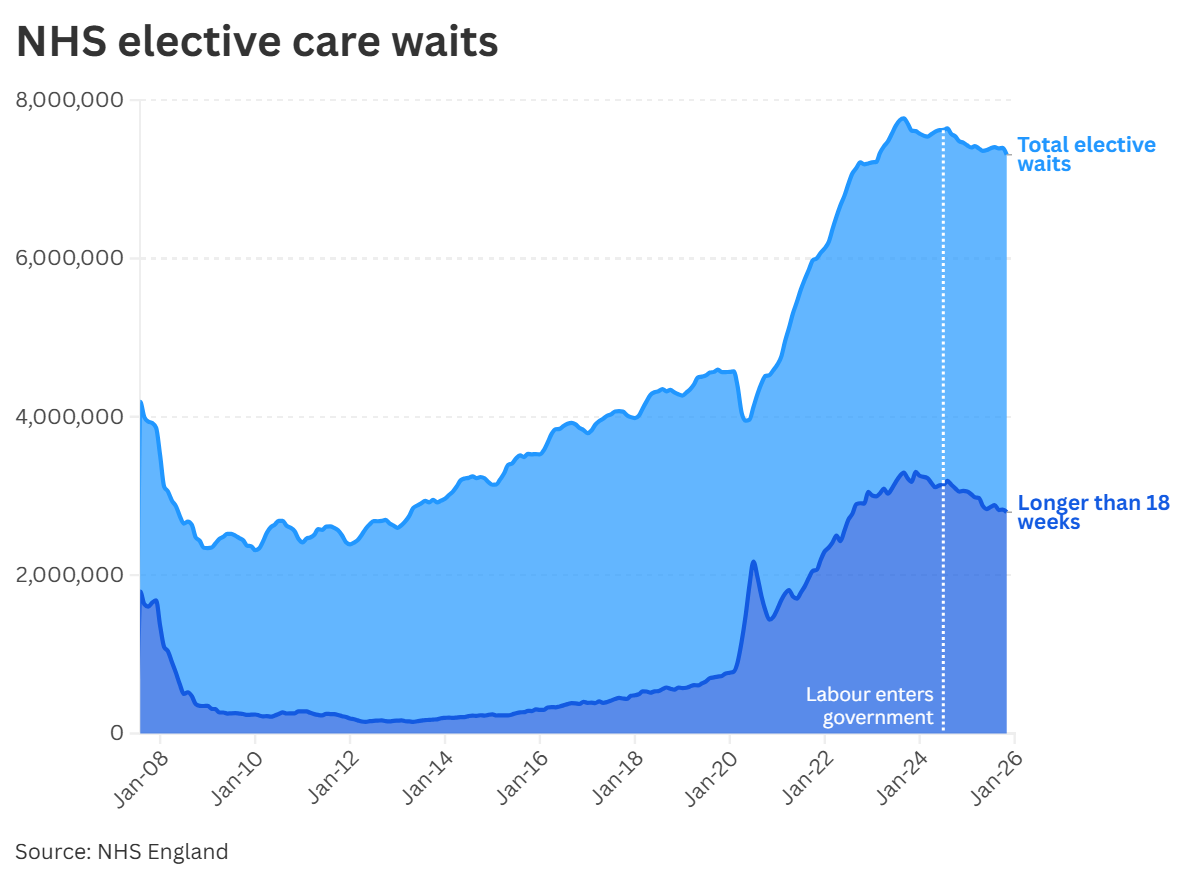
So while the government has overseen a fall in the overall waitlist, there remains a long way to go to meet key performance targets.
One of the most crucial government targets is not merely the size of the waiting list, but the proportion of those on the list who wait longer than 18 weeks for their treatment.
The NHS constitutional standard is for 92 per cent of patients to be treated within 18 weeks of referral.
But that standard hasn’t been met since 2015. The government has committed to restore that standard by the end of the parliament in 2029.
It’s not clear whether it is currently on track to do so.
At the moment, around 62 per cent of waits for elective treatment take less than 18 weeks. But this hasn’t improved over the latest three months of data.
The government has an interim target to hit 65 percent by March 2026. It’s not clear at this point whether it will meet that.
Your chances of facing long waits also depend on what type of treatment you’re waiting for. Some specialties have seen a higher proportion of patients enduring long delays.
Data shows that there are nearly 600,000 people on the waitlist for ear, nose and throat treatment, of whom only 52 per cent have waited less than 18 weeks.
Similarly, there are over 300,000 people on the waitlist for oral surgery, of whom only around 52 per cent have waited less than 18 weeks.
Health and Social Care Secretary Wes Streeting said:
“For too long, patients were promised change in the NHS but saw little of it. This government is turning promises into change people can actually feel.
“November saw the second biggest monthly drop in waiting lists in 15 years. That means faster care, less anxiety for families and people back on their feet and back to work.”